
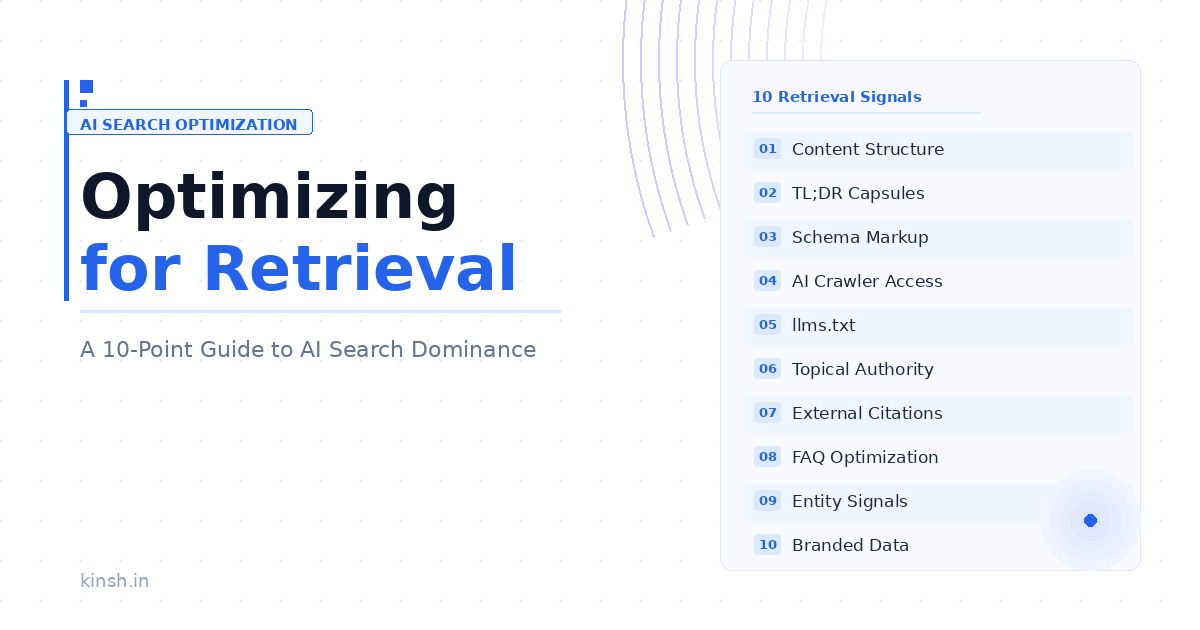
AI search dominance requires optimizing content for retrieval, not just ranking. The 10 core levers are: structured content architecture, schema markup, TL;DR capsules, entity coverage, AI crawler access, topical authority clusters, external citation signals, answer-first writing, FAQPage optimization, and consistent brand entity signals. Miss more than three of these and LLMs will cite your competitors instead.
Google’s first page used to be the finish line. It no longer is. AI Search is the new norm. A growing share of search interactions now end inside an AI-generated answer — in a Google AI Overview, a Perplexity response, a ChatGPT summary — without the user ever clicking a blue link. The question is no longer just “how do I rank?” It is “how do I get cited in ai search?”
The mechanism behind those citations is retrieval. AI search systems — whether they power AI Overviews, LLM-based chat engines, or answer boxes — retrieve, evaluate, and synthesize content from the web before generating a response. Getting your content retrieved consistently, and cited accurately, is what AI search dominance actually means. This guide gives you the 10-point framework to make it happen.
Why AI Search Is Different from Traditional SEO
Traditional SEO is built around one signal: search engine rankings. Write content Google considers authoritative for a query, earn a top-10 position, capture clicks. The entire model depends on a user choosing to click your result.
AI Search works differently. AI systems do not rank pages — they retrieve passages. A large language model evaluating a user’s query pulls structured information from multiple sources, weighs those sources for trustworthiness and relevance, and synthesizes a response. Your content can rank in position 8 and still get cited. Your content can rank in position 1 and never appear in a single AI-generated answer — if it is not structured for extraction.
According to BrightEdge’s 2026 research, AI Overviews now appear in more than 40% of all Google queries. Gartner projects a 25% reduction in traditional search volume by 2026 as users shift to AI-powered interfaces. AI Search is not a future consideration — it is a present-day competitive requirement.
The 10-Point Framework for AI Search Dominance
01. Structure Content for Extraction, Not Just Reading
AI search systems extract passages, not pages. A well-structured page with clear answer-first paragraphs, short sentences, and logical section breaks gives a retrieval system exactly what it needs to pull a citable snippet. Long-form prose paragraphs that bury the answer three sentences in are consistently skipped.
The answer-first structure means stating the direct answer to the section’s implied question in the first one or two sentences, then supporting it with evidence. Every H2 section should work as a self-contained unit — readable and informative even if extracted without the surrounding context.
According to Search Engine Land’s 2025 analysis, pages using answer-first paragraph structures appear in AI Overviews at roughly three times the rate of prose-heavy long-form pages. The structural shift alone — without changing the underlying content quality — moves the needle.
02. Add TL;DR Capsules to Every Key Page
A TL;DR capsule is a 40–60 word self-contained summary placed at the top of a page or section that answers the core query directly. It is the single highest-yield retrieval optimization technique available. AI systems prioritize short, authoritative, standalone passages — and a well-written TL;DR fits that profile precisely.
The capsule should not tease or summarize loosely. It should give the direct answer as if the reader will read nothing else. Perplexity, ChatGPT, and Google AI Overviews all show strong preference for pages that front-load their answer rather than building toward it.
03. Implement Schema Markup — Specifically These Types
Schema markup communicates the structure and meaning of your content directly to crawlers in machine-readable format. For retrieval optimization, the priority schema types are: Article (for all editorial content), FAQPage (for Q&A sections — this is the strongest AI Overview trigger), HowTo (for step-by-step instructional content), Speakable (for content intended to be read aloud by AI assistants), and BreadcrumbList (for navigational context).
Agencies and site owners frequently implement basic meta tags and call it structured data. That is not schema markup. Schema is JSON-LD embedded in the page, validated against Google’s Rich Results Test, and updated to reflect current content. At Kinsh Technologies, we find schema gaps — including FAQPage schema missing on pages with extensive FAQ sections — in over 70% of first-time client audits.
04. Unlock AI Crawler Access in robots.txt
AI platforms send their own crawlers to index the web. Google uses Googlebot for traditional search and a separate agent for AI Overviews. OpenAI uses GPTBot. Anthropic uses ClaudeBot. Perplexity uses PerplexityBot. If any of these are blocked in your robots.txt — intentionally or by an overly broad disallow rule — those platforms cannot index your content and will not cite it.
This is a remarkably common error. A blanket Disallow: / for all bots, or overly aggressive bot-blocking rules carried over from spam-prevention configurations, will exclude AI crawlers without any visible sign of malfunction. The site appears normal; AI visibility is simply zero. Check your robots.txt, confirm each major AI crawler is explicitly permitted, and verify with a crawl simulation tool.
05. Implement an llms.txt File
The llms.txt standard — an emerging convention modeled on robots.txt — provides AI systems with a structured, human-readable guide to a website’s most important content, structure, and key pages. It is not yet universally adopted, but forward-looking AI platforms are beginning to reference it during indexing.
An llms.txt file sits at the root of your domain and specifies: the site’s primary purpose, key content sections, priority pages for AI citation, and any restrictions on AI use of the content. Implementing it now costs very little and positions the site favorably as the standard matures. It is also a strong signal of technical sophistication to any AI SEO audit evaluating your site’s readiness.
06. Build Topical Authority Through Content Clusters
AI retrieval systems evaluate topical authority — the depth and breadth of a site’s coverage on a given subject — as a proxy for source trustworthiness. A single well-written article on a topic generates far less retrieval weight than a pillar page supported by five to eight satellite articles that map the full conceptual territory of the subject.
A content cluster for “AI search optimization” might include a pillar guide on the topic, satellite articles on schema markup implementation, TL;DR writing technique, AI crawler configuration, entity optimization, and GEO strategy. Together, these signal to both Google and LLMs that this domain is a genuine authority source — not a site with one well-optimized page surrounded by thin content.
Semrush’s State of Search report confirms that topical authority clusters correlate with higher AI Overview appearance rates, independent of individual page ranking positions. The cluster effect is real and measurable.
07. Earn External Citations from High-Trust Sources
Large language models are trained on data that reflects the broader web’s citation graph. Brands and domains that are cited, linked to, and referenced by authoritative external sources develop stronger entity representations inside LLMs — meaning those models are more likely to surface them in generated answers.
This is not traditional link building for PageRank. It is citation building for LLM trust signals. The target is coverage in industry publications, reference mentions in high-authority guides, and appearances in research or data sources that LLMs treat as ground truth. A single citation in a Semrush blog post, a Search Engine Journal article, or a G2 category page does more for LLM visibility than dozens of low-authority backlinks.
08. Optimize FAQ Sections Specifically for AI Extraction
FAQ sections are the single most direct retrieval trigger available in on-page content. Google AI Overviews draw disproportionately from FAQPage-schemaed Q&A sections. Perplexity consistently cites pages with well-structured question-and-answer pairs. The reason is structural — a question followed by a direct answer in 40–80 words is exactly the passage format AI retrieval systems are built to extract.
Effective FAQ sections for AI retrieval have three characteristics. First, questions match the exact phrasing of real user queries — not reworded for elegance. Second, each answer starts with a direct response in the first sentence. Third, FAQPage schema is implemented so crawlers can identify the Q&A structure without relying on HTML pattern recognition alone.
Aim for a minimum of five questions per page, targeting secondary keywords and long-tail variants of the primary topic. Pages with fewer than five FAQ items rarely appear in AI Overviews for FAQ-style queries.
09. Build Consistent Brand Entity Signals Across the Web
An “entity” in SEO terms is a real-world concept — a business, person, product, or place — that search engines and LLMs represent as a node in their knowledge graph. The stronger and more consistent a brand’s entity signals across the web, the more confidently AI systems will reference it in generated answers.
Entity optimization involves ensuring the brand name, description, core services, and key facts are stated consistently across all owned and earned digital properties: the website, Google Business Profile, LinkedIn, industry directories, press coverage, and Wikipedia where applicable. Inconsistent information — different founding dates on different pages, varying service descriptions across platforms — weakens the entity signal and reduces LLM confidence in citing the brand.
This is the GEO layer of retrieval optimization — not just optimizing individual pages, but managing the brand’s representation across all the sources AI models use to understand it.
10. Include Branded Insights and First-Party Data
AI retrieval systems favor sources that provide unique, attributable information — data, findings, or expert perspectives that cannot be found anywhere else. Generic content that restates widely known facts has low retrieval value. Content that includes a proprietary statistic, a named expert’s stance, or a first-party data point gives AI models a citable original source rather than a paraphrase of other sources.
A branded insight does not require a formal research study. A sentence like “In our analysis of 200 site audits, we found that 68% had AI crawler access issues in robots.txt” is a citable data point. It names the source, specifies the sample, and states a concrete finding. This is what separates retrievable content from generic content in practice — and it is the reason proprietary data consistently outperforms polished-but-generic content in AI-generated citations.
| Factor | Traditional SEO | Retrieval Optimization (AEO/GEO) |
|---|---|---|
| Primary goal | Page ranking in Google SERPs | Content cited in AI-generated answers |
| Key content unit | Full page | Extractable passage or paragraph |
| Schema priority | Basic meta tags, OG tags | FAQPage, Article, HowTo, Speakable |
| Content structure | Comprehensive, long-form prose | Answer-first, short paragraphs, TL;DRs |
| Link building goal | PageRank and domain authority | LLM trust signals, entity citation graph |
| Crawler focus | Googlebot access | GPTBot, ClaudeBot, PerplexityBot + Googlebot |
| Measurement | Rank tracking, organic traffic | AI Overview appearances, LLM citation monitoring |
| Unique data requirement | Optional, adds value | High priority — LLMs favor attributable original sources |
How to Prioritize These 10 Points for Your Site
Not every point carries equal weight at every stage. Sites with significant existing traffic should prioritize points 1, 2, 3, and 8 first — these improve AI extractability from content that is already reaching users. Sites with thin or unstructured technical foundations should prioritize points 3, 4, and 5 before investing in content improvements.
For newer sites or those entering competitive verticals, points 6 and 7 — topical authority clusters and external citation building — are the most important long-term investments. A single well-optimized page has no retrieval durability against a topical cluster backed by earned citations from authoritative sources.
Run a baseline check before implementing anything. Use Google’s AI Overviews to search queries in your core topic area and note which sites appear. Test your brand name in Perplexity and ChatGPT. Check your robots.txt against each major AI crawler. Audit your top five pages for schema coverage using Google’s Rich Results Test. These four checks take under 30 minutes and will immediately surface the highest-priority gaps.
Frequently Asked Questions (FAQs)
What does “optimizing for retrieval” actually mean in practice?
Optimizing for retrieval means structuring your content so that AI systems — including Google AI Overviews, Perplexity, and ChatGPT — can extract, evaluate, and cite specific passages from your pages when generating answers to user queries. In practice this involves answer-first paragraph structure, TL;DR capsules, schema markup (especially FAQPage), and ensuring AI crawlers can access your site. It is the discipline of writing for machine extraction alongside human readability.
How is retrieval optimization different from Answer Engine Optimization (AEO)?
Retrieval optimization is the technical and structural layer that enables AEO. AEO is the broader practice of optimizing content to appear in AI-generated answers. Retrieval optimization specifically focuses on making content extractable and citable by AI retrieval systems — through structure, schema, passage formatting, and crawler access. AEO encompasses retrieval optimization plus the entity-building and citation-earning strategies that establish source trustworthiness at the brand level.
Which AI platforms should I prioritize for retrieval optimization?
Google AI Overviews should be the first priority for most businesses, given Google’s dominant market share and the direct overlap between AI Overview citations and traditional search authority. Perplexity is the second priority — it cites sources visibly and drives measurable referral traffic for well-optimized content. ChatGPT and Claude are important for brand entity visibility, particularly in B2B and professional services contexts where decision-makers use AI tools for research. Optimize for Google AI Overviews first, then expand to the other channels.
How long does it take to see results from AI Search?
Technical fixes — correcting robots.txt, implementing schema markup, adding TL;DR capsules to existing pages — can produce measurable changes in AI Overview appearances within four to eight weeks. Content restructuring for answer-first formatting typically shows results within two to three months. Building topical authority clusters and LLM citation profiles is a six-to-twelve month programme. The timeline mirrors traditional SEO in that foundational technical work moves faster than authority-building.
Do I need a separate content strategy for AI Search, or can I adapt existing SEO content?
Existing SEO content can be adapted rather than replaced. The most efficient approach is auditing your top 10 highest-traffic pages and retrofitting them with TL;DR capsules, answer-first paragraph restructuring, and FAQPage schema. New content should be written for retrieval from the outset — following answer-first structure throughout. A separate strategy is not required; retrieval optimization is an enhancement layer applied to existing and new content, not a parallel content programme.
What is the llms.txt file and do I actually need one?
The llms.txt file is an emerging standard — modeled on robots.txt — that provides AI systems with a structured guide to a website’s key content, structure, and pages. It sits at the root of your domain and helps AI platforms understand your site’s most important content without relying entirely on crawling inference. It is not yet universally required, but implementing it now is a low-cost signal of AI readiness and positions your site favorably as more platforms begin referencing it during indexing.
Can small or niche sites compete in AI search against large domain-authority sites?
Yes — often more effectively than in traditional search. AI retrieval systems evaluate content relevance and structural quality at the passage level, not just domain authority. A well-structured, authoritative FAQ section on a niche site can outperform a superficially comprehensive page on a high-authority domain if the niche site’s passage is more directly extractable and citable. Niche sites with genuine topical depth and clean retrieval optimization frequently appear in AI-generated answers ahead of generic authority sites covering the same topic broadly.
Conclusion
The shift from ranking optimization to retrieval optimization reflects a fundamental change in how people interact with search. Users increasingly want answers, not links — and AI systems are built to provide them by extracting and synthesizing the best available content. Businesses that structure their content for retrieval now will hold a durable advantage as this shift accelerates.
The 10-point framework in this guide covers every layer of retrieval optimization: content structure, schema implementation, crawler access, topical authority, entity signals, and branded data. None of these points is technically complex in isolation. The challenge is implementing all 10 consistently across a site, maintaining them as content updates, and treating retrieval optimization as an ongoing discipline rather than a one-time project.
If you want to audit your current AI search visibility and identify which of these 10 points are costing you the most citations, get in touch with the Kinsh Technologies team — we will run a full retrieval audit and show you exactly where your content is and is not getting extracted.
