
Every company today wants an AI product.
Few are ready for one.
Across industries, management teams are investing in chatbots, copilots, internal assistants, and AI powered features. Yet lots of those task’s stall. Not due to the fact AI models fail. They stall due to the fact the organization lacks AI workflows.
There is a essential difference among adding AI functions and constructing AI infrastructure. The agencies a good way to win inside the AI economy aren’t those shipping flashy tools. They are the ones remodeling how work flows through their organization.
Before you build AI products, build AI workflows.
The Real Problem: AI Without Operational Integration
Most AI initiatives follow this pattern:
- Leadership approves an AI experiment
- A proof of concept is built
- The tool works in isolation
- Adoption stagnates
The missing layer is workflow integration.
AI tools that are not embedded inside operational systems create friction. Teams still move data manually. Approvals still require emails. Context still gets lost between departments.
AI should reduce operational entropy. Instead, many deployments increase it.
The solution is not more AI tools. It is intelligent workflow architecture and AI workflow automation in India.
What Is an AI Workflow?
An AI workflow is not simple automation.
Basic automation follows static rules:
If X happens, trigger Y.
An AI workflow is dynamic. It uses context, decision logic, and data awareness to adapt.
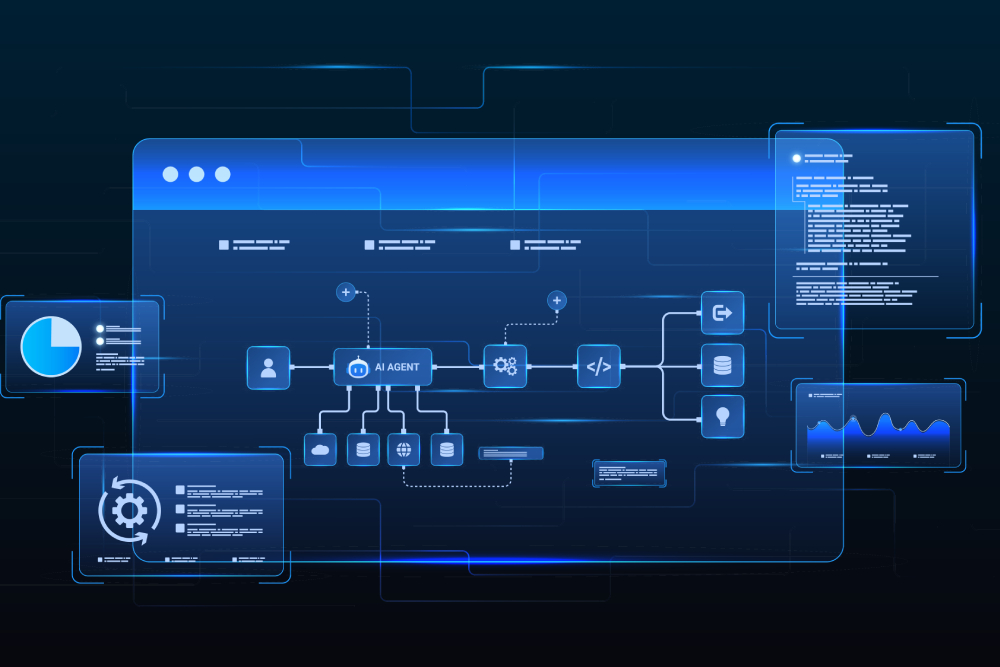
A mature AI workflow system includes:
- Data ingestion layer
- Context understanding layer
- Decision engine powered by AI models
- Action execution layer
- Feedback loop for continuous improvement
- Optional human in the loop checkpoints
Instead of automating tasks, it orchestrates outcomes.
That distinction matters.
Why AI Products Fail Without AI Workflows
Let’s break this down in practical terms.
Imagine you build an AI powered lead qualification bot.
It can:
- Answer website queries
- Score leads
- Collect contact information
Sounds useful.
But what happens next?
If there is no AI workflow:
- Leads are manually exported
- Sales reviews them in batches
- Follow ups are inconsistent
- CRM updates lag
The AI product becomes a glorified form.
Now imagine the same system inside an AI workflow:
- Lead arrives
- AI qualifies and scores in real time
- High intent leads are routed instantly
- Calendar invites auto scheduled
- CRM updated
- Follow up email personalized
- Sales dashboard updated
- Weekly performance report generated
The difference is architectural.
One is a tool. The other is a system.
The Shift from Task Automation to AI Orchestration
Most businesses are still in the “automation” mindset.
They use tools like:
- Zap based integrations
- Simple trigger workflows
- Manual oversight processes
These reduce repetitive tasks but do not introduce intelligence.
AI workflow architecture introduces orchestration.
Orchestration means:
- Multiple tools connected through a central intelligence layer
- AI models making decisions across systems
- Data flowing bidirectionally
- Continuous optimization based on outcomes
This is where operational leverage is created.
Companies that adopt orchestration see improvements in:
- Sales cycle speed
- Marketing execution consistency
- Customer response times
- Internal reporting accuracy
- Decision velocity
Speed compounds advantage.
AI Workflows Across Departments
The biggest mistake companies make is thinking AI belongs only in product or tech.
AI workflows transform internal operations first.
Marketing
- Automated content research
- AI assisted campaign planning
- Performance anomaly detection
- Predictive content optimization
Instead of reacting to metrics, teams operate proactively.
Sales
- Real time lead scoring
- AI assisted proposal drafting
- Follow up sequencing
- Opportunity risk prediction
Sales becomes data driven instead of instinct driven.
Customer Support
- Ticket triage
- Sentiment detection
- Escalation prediction
- Resolution knowledge generation
AI workflows reduce resolution time while maintaining quality.
Operations
- Invoice processing
- Procurement validation
- Vendor analysis
- Compliance monitoring
Operational efficiency increases without scaling headcount.
AI Workflows Create Competitive Moats
AI features can be copied.
AI workflows are harder to replicate.
Why?
Because they are deeply embedded into your organization’s:
- Data structure
- Decision patterns
- Customer behavior insights
- Internal knowledge
Over time, workflows improve through feedback loops. The AI learns from historical decisions. It adapts to patterns. It optimizes based on business outcomes.
This creates compounding intelligence.
Competitors may use similar models. They will not have your operational data ecosystem.
That becomes your moat.
The Architecture Behind Effective AI Workflows
Serious AI workflow implementation and AI workflow services requires structured thinking.
Key architectural components include:
- API Orchestration Layer
Connects CRM, marketing tools, ERP systems, analytics platforms.
- LLM Decision Engine
Handles context interpretation, content generation, and reasoning.
- Data Pipeline
Cleans and standardizes incoming data for model reliability.
- Rule Based Safeguards
Ensures compliance and governance standards.
- Human Review Nodes
Maintains quality control for critical processes.
Without this layered approach, companies end up with fragile automation chains.
With it, they build intelligent systems.
Why This Matters Now
The AI economy is not defined by who uses AI.
It is defined by who operationalizes AI.
In the next three years, businesses will fall into two categories:
- Those using AI as a productivity add on
- Those running core processes through AI workflows
The second group will operate faster, make fewer errors, and scale without proportional hiring.
AI products create visibility.
AI workflows create advantage.
Where Most Companies Go Wrong
Three common mistakes:
- Tool first thinking
Buying AI software before mapping internal processes.
- No data audit
Poor data quality leads to unreliable outputs.
- No governance framework
Without oversight, AI workflows introduce risk.
AI workflow implementation must start with process mapping and operational redesign. Technology comes second.
Final Thought
Building an AI product is exciting.
Building AI workflows is transformational.
If your company wants to compete seriously within the AI financial system, start through redesigning how work moves through your organization. Map decisions. Identify friction. Create intelligence layers.
Then introduce AI.
The organizations that deal with AI as infrastructure will outpace people who treat it as a feature.
And that gap will widen each year.
