
Summary
What Is AI SEO?
AI SEO refers to the use of artificial intelligence and machine learning technologies to optimize websites for search engines. Unlike traditional SEO methods that rely heavily on manual research and implementation, AI-powered SEO uses algorithms to analyze massive datasets, identify patterns, and make data-driven decisions automatically.
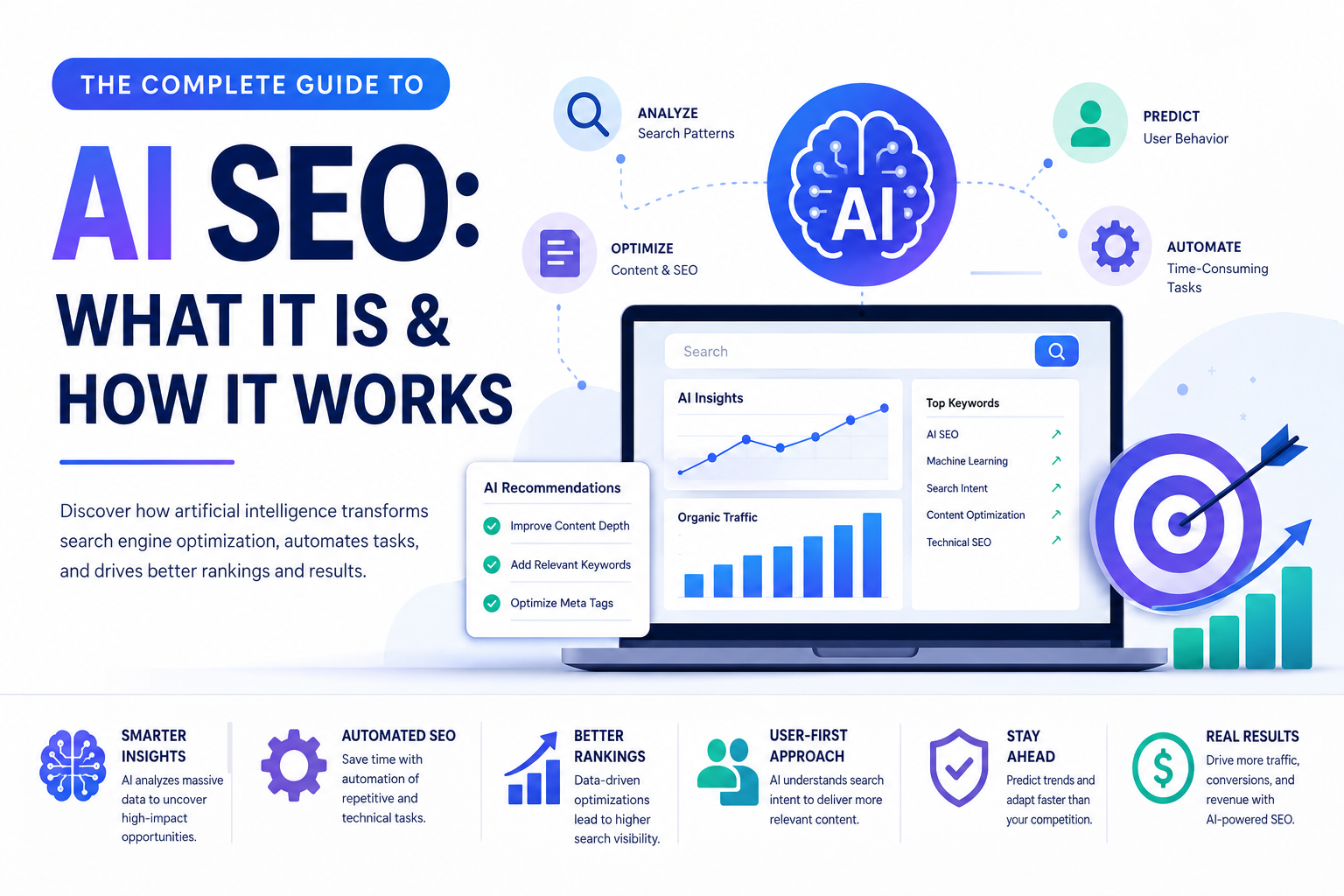
At its core, AI SEO combines three fundamental elements:
- Machine Learning Algorithms — These systems learn from historical data to predict which optimization strategies will perform best. They continuously improve their recommendations based on actual results.
- Natural Language Processing (NLP) — AI uses NLP to understand search intent, analyze content quality, and determine semantic relationships between keywords and topics.
- Predictive Analytics — By examining user behavior patterns and search trends, AI forecasts which content types and keywords will generate the most organic traffic.
The technology doesn’t replace human expertise entirely. Instead, it handles repetitive, data-intensive tasks while allowing SEO professionals to focus on strategy and creative execution.
Free Strategy Call
Ready to Grow with AI-Powered SEO?
Let’s build a custom SEO strategy for your business. No commitments – just actionable insights.
No Obligations
Reply in 2 Hrs
Your information stays private & secure
How Does Artificial Intelligence Help SEO?
Artificial intelligence transforms SEO through several practical applications that address common challenges marketers face daily.
Pattern Recognition at Scale
AI examines millions of search queries to identify patterns humans might miss. It recognizes which content formats perform best for specific query types, which keywords correlate with higher conversion rates, and which technical factors influence rankings most significantly.
Content Optimization
Machine learning algorithms analyze top-ranking content to understand what makes it successful. They evaluate factors like reading level, semantic keyword usage, content structure, and comprehensiveness. AI tools then provide specific recommendations to improve your content’s competitive positioning.
Technical SEO Monitoring
AI continuously monitors website health, instantly flagging issues like broken links, slow page speeds, or crawl errors. Rather than waiting for manual audits, the system alerts you to problems that could harm rankings.
Search Intent Analysis
Understanding what users actually want when they type a query is critical. AI analyzes click patterns, bounce rates, and engagement metrics to determine true search intent, helping you create content that satisfies user needs.
Competitive Intelligence
AI tracks competitor strategies in real-time, identifying new keywords they’re targeting, content gaps in your coverage, and backlink opportunities you might have missed.
Key Components of AI-Powered SEO
Understanding the building blocks of AI SEO helps you evaluate tools and strategies more effectively.
1. Data Collection and Processing
AI systems gather information from multiple sources — search console data, analytics platforms, ranking trackers, and even competitor websites. The technology processes this information far faster than manual analysis, identifying actionable insights within minutes rather than hours.
2. Algorithm Training
Machine learning models require training on relevant datasets. In SEO, this means feeding the algorithm historical ranking data, content performance metrics, and user behavior patterns. Over time, the model learns which factors correlate with success.
3. Automated Recommendations
Once trained, AI systems generate specific, actionable recommendations. Instead of generic advice like “improve your content,” you receive precise guidance such as “add 300 words covering [specific subtopic]” or “target [specific keyword] in H2 headings.”
4. Performance Prediction
AI forecasts the potential impact of optimization changes before you implement them. This helps prioritize efforts on high-impact tasks rather than wasting time on low-value activities.
5. Continuous Learning
Unlike static tools, AI systems improve with use. They analyze the results of implemented recommendations and adjust future suggestions accordingly, creating a feedback loop of ongoing improvement.
Free Strategy Call
Ready to Grow with AI-Powered SEO?
Let’s build a custom SEO strategy for your business. No commitments – just actionable insights.
No Obligations
Reply in 2 Hrs
Your information stays private & secure
How AI Algorithms Analyze Search Patterns
Search engines process billions of queries daily, creating enormous datasets that reveal user behavior and preferences. AI makes sense of this complexity through sophisticated analysis methods.
Query Clustering
AI groups similar search queries together, even when they use different words. For example, “best smartphone 2026,” “top mobile phones this year,” and “which phone to buy now” all represent similar intent. This clustering helps identify comprehensive topic coverage opportunities.
Temporal Pattern Detection
Search behavior changes throughout the day, week, and year. AI identifies these temporal patterns, revealing when specific content types perform best and how seasonal trends affect search volume.
User Journey Mapping
By analyzing sequences of searches, AI reconstructs typical user journeys. This shows how people progress from initial research to final decision-making, allowing you to create content for each stage.
Semantic Relationship Analysis
AI understands that words and concepts connect in meaningful ways. It identifies related topics, supporting keywords, and contextual terms that strengthen content relevance without keyword stuffing.
Ranking Factor Correlation
Machine learning examines thousands of ranking factors simultaneously, determining which combinations produce the best results for specific query types. This reveals optimization priorities that manual analysis might overlook.
Traditional SEO vs. AI-Powered SEO: A Detailed Comparison
| Aspect | Traditional SEO | AI-Powered SEO |
|---|---|---|
| Keyword Research | Manual research using tools; relies on human judgment | Automated pattern recognition across millions of queries; intent-based clustering |
| Content Creation | Human-written; optimized post-creation | AI-assisted drafting, real-time optimization recommendations, semantic enhancement |
| Technical Audits | Periodic manual audits; reactive to issues | Continuous automated monitoring; proactive issue detection |
| Competitive Analysis | Occasional reviews; snapshot-based | Real-time competitor tracking; gap identification at scale |
| Link Building | Manually identified outreach targets | AI-identified high-relevance link opportunities based on authority and traffic value |
| Reporting | Weekly or monthly manual reporting | Real-time dashboards with predictive forecasts |
| Time Investment | High — most tasks require manual effort | Lower — AI handles repetitive data tasks; humans focus on strategy |
| Scalability | Limited by team size and bandwidth | Scales with data; handles thousands of pages simultaneously |
| Adaptability | Reactive to algorithm updates | Predictive — learns from pattern changes and adapts automatically |
Machine Learning Applications in SEO Optimization
Machine learning brings specific capabilities that transform how optimization actually works in practice.
Content Gap Identification
ML algorithms compare your content library against top-ranking competitors, identifying topics you haven’t covered and subtopics where your coverage is insufficient. This creates a roadmap for content expansion based on actual ranking opportunities.
Title and Meta Description Testing
Instead of guessing which titles will generate more clicks, machine learning tests variations and predicts performance before you publish. Some advanced systems automatically adjust titles for different audience segments.
Internal Linking Optimization
AI maps your site structure and recommends internal links that improve topical authority and user navigation. It identifies orphaned pages and suggests the optimal anchor text for each link.
Image Optimization
Machine learning analyzes images to generate descriptive alt text automatically, compress files without visible quality loss, and recommend which images will increase engagement.
Schema Markup Generation
Rather than manually coding structured data, AI systems identify opportunities for schema markup and generate the correct code automatically, helping you capture rich snippets in search results.
Conversion Rate Optimization
ML tracks which organic landing pages convert best and identifies common elements. It then recommends changes to underperforming pages based on successful patterns.
Free Strategy Call
Ready to Grow with AI-Powered SEO?
Let’s build a custom SEO strategy for your business. No commitments – just actionable insights.
No Obligations
Reply in 2 Hrs
Your information stays private & secure
What Does an AI SEO Agency Do?
AI SEO agencies combine artificial intelligence technology with human expertise to deliver comprehensive optimization services. Understanding their role helps you decide whether to build in-house capabilities or partner with specialists.
Strategy Development
Agencies use AI tools to analyze your market, competitors, and current performance, then develop data-driven strategies aligned with business goals. Human strategists interpret AI insights and make final decisions.
Implementation and Execution
While AI identifies opportunities, agencies handle the actual implementation — creating content, building links, fixing technical issues, and optimizing conversion paths.
Tool Access and Management
Enterprise-level AI SEO tools often cost thousands monthly. Agencies provide access to these platforms as part of their service, managing multiple tools in an integrated workflow.
Continuous Optimization
AI SEO isn’t a one-time project. Agencies monitor performance continuously, using machine learning to identify when strategies need adjustment and implementing changes proactively.
Reporting and Analysis
Agencies translate AI-generated data into business-relevant insights, showing not just rankings but actual revenue impact and ROI from optimization efforts.
Training and Knowledge Transfer
Quality agencies educate clients about AI SEO concepts, ensuring internal teams understand the strategy and can contribute effectively.
How AI SEO Tools Improve Website Rankings
AI-powered SEO tools deliver ranking improvements through several specific mechanisms that address known ranking factors.
Content Quality Assessment
AI tools analyze your content against Google’s quality guidelines, checking factors like expertise demonstration, comprehensiveness, readability, and user engagement signals. They provide specific revision recommendations that align with what search engines value.
Keyword Intent Matching
These tools ensure your content matches the actual intent behind target keywords. If users searching for “best CRM software” want comparison articles, not product pages, AI identifies this mismatch and recommends the appropriate content format.
Technical Performance Optimization
AI monitors core web vitals, mobile usability, and other technical ranking factors. When performance degrades, the system identifies the specific cause and recommends fixes, often automatically implementing simple corrections.
Topical Authority Building
Machine learning maps topic clusters and identifies content needed to establish subject matter authority. This strategic approach to content creation signals expertise to search algorithms.
User Experience Enhancement
AI tracks user behavior metrics like time on page, scroll depth, and click patterns. It identifies where users disengage and recommends specific UX improvements that reduce bounce rates and increase dwell time.
Link Quality Evaluation
Rather than pursuing maximum link quantity, AI tools assess link quality based on relevance, authority, and traffic value. This focuses effort on backlinks that actually move rankings.
Real-World Examples of AI-Driven SEO Results
Actual case studies demonstrate how AI SEO delivers measurable business outcomes across different industries.
E-Commerce Success Stories
PlushBeds achieved a 753% surge in large language model traffic and a 950% lift in AI Overview visibility within 5 months. This dramatic increase came from optimizing content structure for AI citations and implementing comprehensive schema markup.
Rocky Brands saw a 30% increase in search revenue and 74% year-over-year revenue growth by using AI tools for keyword research and content optimization that better aligned with user search queries.
Technology Platform Results
Codewars experienced a 22x increase in Copilot traffic and 2x growth in Gemini traffic in just 3 months. The technology education platform focused on creating extractable content that AI systems could easily cite and reference.
Educational Platform Growth
Brainly tripled their keyword rankings year-over-year, with users generating over 2 million question landing pages. The peer-to-peer learning platform’s user-generated content strategy aligned perfectly with AI’s preference for comprehensive, question-based content.
GMAT Club achieved a 199% boost in ChatGPT-related traffic over 6 months by restructuring existing content to answer specific questions that prospective students ask AI assistants.
Service Industry Improvements
Fugue’s Cloud Security Posture Management page advanced from 10th position to 1st place after using AI-powered content optimization tools to identify missing topics and compare against best-performing content in their segment.
2026 AI SEO Statistics You Need to Know
The latest data reveals how rapidly AI is reshaping the search landscape and what it means for optimization strategies.
Free Strategy Call
Ready to Grow with AI-Powered SEO?
Let’s build a custom SEO strategy for your business. No commitments – just actionable insights.
No Obligations
Reply in 2 Hrs
Your information stays private & secure
AI Search Adoption
- Monthly sessions of AI are now 56% the size of search worldwide, with search-related usage of AI at 28% the size of search worldwide.
- Around 3 in 4 American respondents say they search with AI weekly, with top use cases including quick facts, shopping research, and health information.
- Nearly 35% of Gen Z people in the U.S. use AI chatbots to search for information, indicating younger demographics lead AI search adoption.
AI Overview Impact
- 2 billion monthly users engage with AI Overviews across 200+ countries and 40 languages.
- The average click-through rate on position 1 is 34.5% lower due to an AI Overview, fundamentally changing the value proposition of traditional ranking positions.
- 76.1% of URLs cited in AI Overviews also rank in Google’s top 10, however, 40% of AI Overview citations come from pages ranking below position 10.
Marketing AI Adoption
- About 94% of marketers plan to integrate AI into their content creation and blogging workflows throughout 2026.
- 86% of SEO professionals have integrated AI into their workflows, recognizing that traditional optimization alone is no longer sufficient.
- AI-driven SEO can boost organic traffic by 45% and conversion rates by 38% for e-commerce websites.
AI SEO Tools Market Growth
The AI SEO tools market is projected to grow from $1.2 billion in 2024 to $4.5 billion by 2033, representing a Compound Annual Growth Rate of 15.2%. This explosive growth reflects increasing investment in AI optimization capabilities.
Traffic Quality Differences
Traffic from large language models rose from about 17,000 to 107,000 sessions when comparing January–May 2024 with the same period in 2025, showing 527% growth.
Getting Started with AI SEO Tools for Beginners
If you’re new to AI-powered SEO, starting with the right approach prevents overwhelm and delivers quick wins.
Choose Your First AI SEO Tool
Begin with tools that address your biggest pain point. If content creation takes too much time, start with AI writing assistants. If keyword research feels overwhelming, begin with AI-powered keyword tools that analyze search intent automatically.
Popular beginner-friendly options include:
- AI Writing Assistants — Tools like ChatGPT, Jasper, or Copy.ai help generate content outlines, meta descriptions, and draft articles based on your target keywords.
- AI Keyword Research Tools — Platforms like Semrush, Ahrefs, or SurferSEO use machine learning to identify keyword opportunities and search intent patterns.
- AI Content Optimization — Tools like Clearscope or MarketMuse analyze top-ranking content and provide specific recommendations to improve your pages.
Start with Small Experiments
Don’t overhaul your entire SEO strategy at once. Pick one category of pages (like blog posts or product descriptions) and test AI optimization on a small subset. Track performance compared to your traditional approach.
Combine AI Insights with Human Judgment
AI excels at pattern recognition and data analysis, but humans understand context, brand voice, and strategic priorities. Review all AI-generated recommendations before implementation and adjust based on your specific business needs.
Monitor AI Search Visibility
Use tools that track your appearance in AI-generated answers. Understanding how often ChatGPT, Perplexity, or Google AI Overviews cite your content helps measure the effectiveness of your optimization efforts.
Focus on Structured Data
Every successful case study featured comprehensive schema markup. Implementing proper structured data gives AI systems clear signals about your content’s meaning and context.
Common Challenges and Solutions in AI SEO
Even with powerful technology, AI SEO presents specific challenges that require thoughtful approaches.
Challenge: AI-Generated Content Quality Concerns
The Problem: Search engines have stated they penalize low-quality content, whether AI-generated or human-written. Many worry that AI content might trigger quality filters.
The Solution: 86% of marketers review and edit AI generated content before publishing. Use AI as a starting point, then add unique insights, examples, and expertise that only your team can provide. This hybrid approach combines AI efficiency with human value-add.
Challenge: Declining Click-Through Rates
The Problem: Around 93% of AI Mode searches end without a click, meaning fewer users visit websites even when search visibility increases.
The Solution: Optimize for being cited within AI answers rather than just ranking in search results. Create content designed to be extracted and referenced, positioning your brand as the authoritative source even when users don’t click through.
Challenge: Different AI Platforms Cite Different Sources
The Problem: LLMs like ChatGPT and AI Mode tend to draw from a wider range of sources, often citing lower-ranking or even non-ranking pages if they provide contextually relevant information.
The Solution: Build a multi-platform presence. Publish content across your website, industry forums, review sites, and social platforms. Websites with more organic traffic tend to get more mentions in AI Overviews and Perplexity, so traditional SEO still supports AI visibility.
Challenge: Keeping Content Fresh
The Problem: AI systems show clear preference for recently updated content. Outdated information reduces citation likelihood.
The Solution: Implement regular content audits and refreshing schedules. Update statistics, add new sections covering recent developments, and revise examples to reflect current best practices.
Challenge: Technical Implementation Complexity
The Problem: Advanced AI SEO techniques like comprehensive schema markup require technical knowledge many content teams lack.
The Solution: Start with schema plugins for your content management system, or partner with an AI SEO agency that handles technical implementation while training your team on strategic concepts.
Free Strategy Call
Ready to Grow with AI-Powered SEO?
Let’s build a custom SEO strategy for your business. No commitments – just actionable insights.
No Obligations
Reply in 2 Hrs
Your information stays private & secure
Frequently Asked Questions About AI SEO
How is AI SEO different from regular SEO?
AI SEO uses machine learning and artificial intelligence to automate data analysis, identify patterns across massive datasets, and make optimization recommendations that would take humans weeks to discover manually. Regular SEO relies primarily on human research, analysis, and implementation. AI SEO handles the repetitive, data-intensive work while humans focus on strategy and creative execution.
Can AI completely replace human SEO experts?
No. While AI excels at data analysis, pattern recognition, and automation, human expertise remains essential for strategic decision-making, understanding business context, maintaining brand voice, and interpreting AI recommendations. 72% of marketing roles will be impacted by generative AI, including 69% of SEO Specialists, but this represents transformation rather than replacement. The most effective approach combines AI efficiency with human judgment.
How much does AI SEO cost compared to traditional SEO?
Initial investment in AI SEO tools is typically higher — enterprise platforms can cost $500 to $5,000+ monthly. However, the time savings reduce ongoing labor costs significantly. Traditional SEO might require 20–40 hours per month of analyst time, while AI SEO tools automate much of that work, allowing smaller teams to manage larger projects effectively.
How long does it take to see results from AI SEO?
Results vary based on your starting position, competition level, and implementation quality. Most businesses see initial improvements in 3–6 months, with significant results in 6–12 months. AI SEO typically shows faster initial gains than traditional approaches because optimization happens continuously rather than in periodic bursts.
Do I need technical skills to use AI SEO tools?
Most modern AI SEO tools are designed for non-technical users, with intuitive interfaces and clear recommendations. Basic digital marketing knowledge helps you interpret results, but you don’t need coding skills for most platforms. Technical implementations like schema markup can often be handled through plugins or agency partnerships.
Is AI SEO suitable for small businesses?
Yes — AI SEO is particularly valuable for small businesses because it multiplies the impact of limited resources. A small team using AI tools can compete effectively with larger companies that rely solely on manual processes. The key is choosing tools appropriate for your budget and starting with high-impact, low-complexity implementations.
