
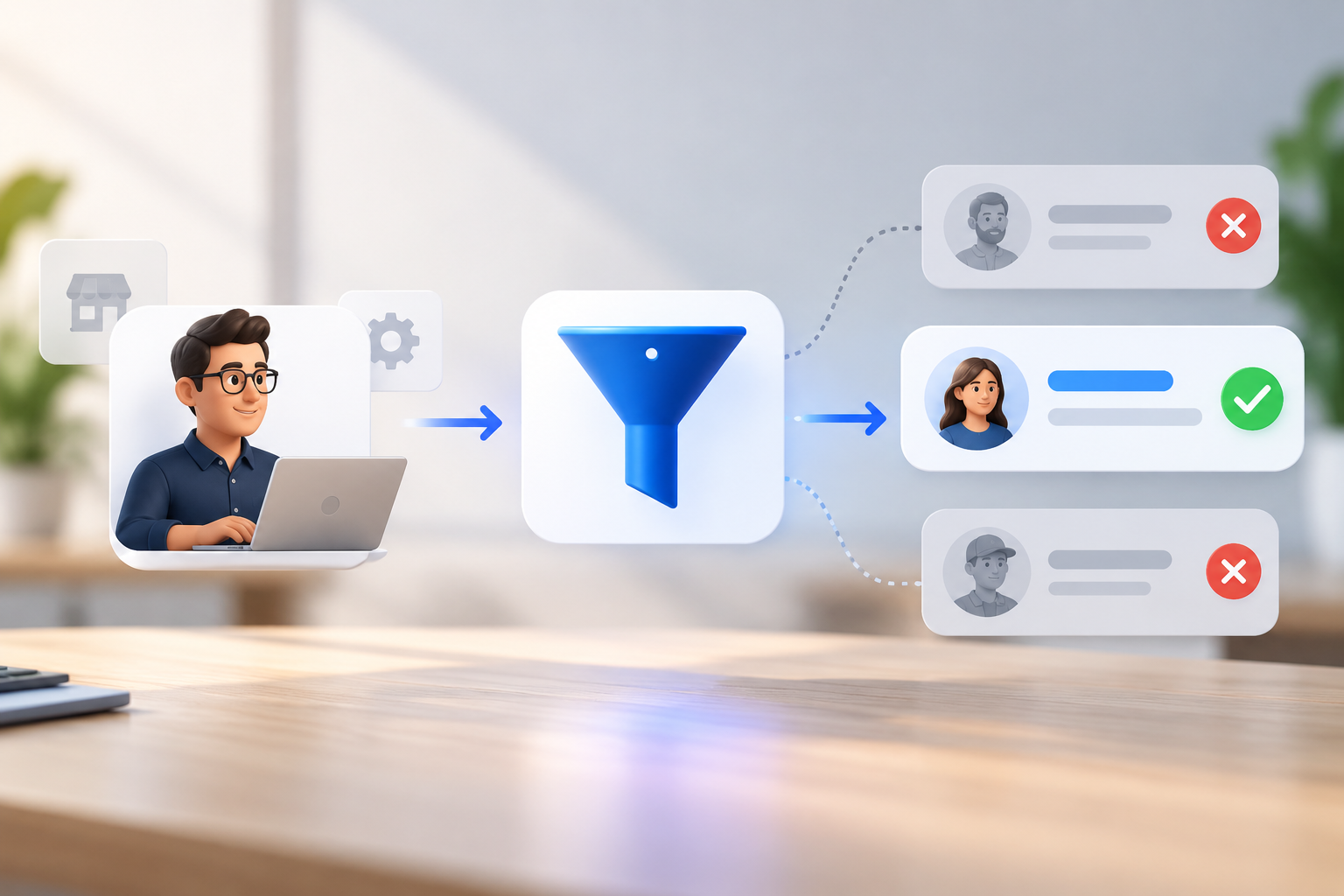
AI SEO for small businesses usually gets pitched as a visibility problem: get mentioned more, get cited more. Often the real problem is fit. A buyer asks an assistant for something very specific, the assistant can’t tell whether you’re the right pick, and it names a competitor who simply spelled it out.
TL;DR
- AI SEO for small businesses isn’t only about being mentioned more. It’s about being the obvious match for one specific buyer.
- Assistants break a buyer’s question into constraints: who they are, how big they are, what they need and what they don’t want.
- A page that says who you serve, who you don’t and who to call instead gives AI a sentence it can quote without guessing.
- Put the same fit statement on your service pages, About page, FAQ and business profiles, then test it in a private window, the cheapest check in AI SEO for small businesses.
What AI Does With a Specific Buyer Question
People don’t type three-word queries into assistants. They write the whole situation. “I’m a freelance photographer with about twenty clients. Who’s a good bookkeeper that won’t try to sell me payroll software?” That one sentence holds a customer type, a size, a service and an exclusion.
Most assistants that search the web do something close to this: they split the question into constraints, then look for pages that state those constraints plainly. Pages that do get used. Pages that talk around the point get skipped, because the assistant would have to guess, and guessing about a recommendation is risky for the assistant too. That’s why AI SEO for small businesses starts with the wording on your pages, not your ad budget.
This matters more for AI SEO for small businesses than for big brands. A large company is recommended on name recognition. A small one only gets named when its pages say exactly who it helps. For a broader view of the shift, this piece on how AI search is changing digital marketing for small businesses is a useful companion read.
Why “We Serve Everyone” Is Invisible to AI
Look at the average small business homepage. “We help businesses of all sizes grow online.” “Tailored solutions for every client.” Those lines match every question a little and none of them strongly.
Now picture the assistant trying to quote you. It needs a clean sentence it can lift without adding anything of its own. “Businesses of all sizes” gives it nothing to lift. It will reach for the competitor whose page says “dental practices with one to five dentists” because that line answers the question as asked.
There’s a human cost too. A vague page attracts vague enquiries: the wrong size, the wrong budget, the wrong expectations. Every one of those costs you a call. Saying no early on the page is cheaper than saying it on the phone, and it’s one of the quieter wins in AI SEO for small businesses.
Weak copy is the most common gap in AI SEO for small businesses, and the cheapest one to fix.
What a Good Fit Statement Looks Like
A fit statement has five parts. Say who it’s for, in specific terms. Say what size or stage they usually are. Say what you do. Say what you don’t do or who isn’t a good match. Then say who to call instead. Here’s an illustrative one for a web developer.
And one for a bookkeeper.
Neither statement is clever. Both are quotable, which is the point in AI SEO for small businesses. An assistant can lift either one almost word for word and be right.
AI SEO for Small Businesses: Where to Put the Fit Statement
In AI SEO for small businesses, one paragraph in one place isn’t enough. Assistants cross-check, so the statement needs to appear wherever your business is described.
- Service pages. In the top third, not buried under a long intro.
- The About page. One short paragraph, written in plain first person.
- FAQ section. “Who is this service for?” and “Who is it not for?” make natural questions.
- Google Business Profile. Work the main idea into the description.
- LinkedIn and directory listings. Same wording, trimmed to fit.
Consistency is the part people skip. If your site says “clinics and practices” and your directory listing says “all small businesses”, the mixed signal weakens both. This is the Consistency layer in our AI Trust Stack, and it’s cheap to fix because you control most of those pages.
The Refer-Out Line Is the Trust Signal
The last sentence of a fit statement does the most work. “For those, a Shopify specialist will serve you better” sounds like a risk to a nervous owner. It isn’t. It tells a reader, and a model reading the page, that you know where your skills end.
I can’t point to a study showing assistants weight that line directly, and I won’t pretend otherwise. What’s easy to defend is the mechanism. A page that draws honest lines reads like a source that knows its field, and Google’s guidance on helpful, people-first content asks for exactly that kind of first-hand, reader-first content. Pages like that are easier to quote correctly, which is the whole game in AI SEO for small businesses, and a business that gets quoted correctly gets better-matched leads.
A Quick Example: Two Bookkeepers, One Question
Here’s an illustrative case, not a real client. Two bookkeepers work in the same town. One site says “Bookkeeping and accounting services for businesses of all sizes.” The other says “Monthly bookkeeping for freelancers and sole traders. We don’t do payroll or multi-company groups.”
A freelancer asks an assistant for a bookkeeper who won’t push payroll. The first site has no sentence that answers that. The second has one, and it answers both halves of the question. That is AI SEO for small businesses working the way it should. The second bookkeeper gets named. Nothing about their service is better. Their page is just easier to match, which is most of what AI SEO for small businesses comes down to.
Fit Statements for Different Kinds of Small Business
The pattern works across very different firms. The details change, the structure doesn’t.
- Local service firms. Name the area, the property type and the job size you take on.
- Consultants and freelancers. Name the industry, the stage of company and the problem you solve, plus the problem you don’t.
- Online shops. Name the product niche, the order volume you handle and the countries you ship to.
- Agencies. Name the platforms you build on, the size of client you suit and the work you refer out.
If you can’t write the exclusion, that’s useful information. It usually means the offer itself is still too broad for AI SEO for small businesses to work, and fixing that helps your sales as much as your search presence.
How Fit Statements Support Your Wider AI SEO for Small Businesses Plan
A fit statement isn’t a trick, and it isn’t the whole of AI SEO for small businesses either. It sits alongside the rest of a sensible AI SEO for small businesses plan: consistent facts, clear structure, other sites that confirm what you say, and content that stays current.
It also gives the other pieces something to point at. Your directory listings, your reviews and any articles written about you all become more useful when they repeat the same description. One sharp sentence, repeated in several trusted places, carries more weight than five different descriptions of the same business.
Keep the Statement Current
Fit changes. You add a service, raise your minimum project size or stop taking a type of work. When that happens, update every place the statement lives on the same day. An out-of-date fit statement is worse than a vague one, because it sends the wrong buyers with confidence. Put a review date in your calendar every quarter and treat it like any other piece of AI SEO for small businesses maintenance.
Vague Claims vs Specific Fit Statements
Use this table when you rewrite your own pages. The right-hand column is the shape to aim for.
| Business | Vague line | Specific fit line |
|---|---|---|
| Bookkeeper | We help businesses stay on top of their finances. | Monthly bookkeeping for freelancers and sole traders. No payroll. |
| WordPress developer | Custom websites for every business. | WordPress sites for clinics and practices with up to twenty staff. |
| Marketing consultant | Growth strategies tailored to you. | Local lead generation for home-service firms. Not for online stores. |
| Cleaning company | Quality cleaning at fair prices. | Weekly office cleaning for spaces under 3,000 sq ft. No construction cleanups. |
Mistakes to Avoid When You Write “Who We Don’t Serve”
Writing the statement is easy to get wrong. These are the mistakes that hurt AI SEO for small businesses most often.
- Sounding superior. “We don’t work with small clients” reads as snobbery. State the fit, not a ranking.
- Listing ten exclusions. Two or three clear ones beat a wall of negatives.
- Hiding it in the footer. If it’s the last thing on the page, it’s the last thing anyone reads.
- Contradicting other pages. The homepage says one thing, the service page says another, and the directory says a third.
- Fearing the lost leads. You’ll lose some. They were the wrong leads. The ones who stay will be easier to close.
How to Test AI SEO for Small Businesses in Ten Minutes
Open a private window and, if you can, log out of your AI accounts. A logged-in assistant may remember earlier chats and answer more kindly than it would for a stranger.
- For AI SEO for small businesses, write three questions as your ideal customer would ask them, including size and one exclusion.
- Write one question as a wrong-fit customer would ask.
- Ask all four in ChatGPT, Perplexity, Gemini and Google’s AI Overviews.
- Note who gets named, how they’re described and which pages are cited.
Two results matter for AI SEO for small businesses. Are you named for the right customer? And are you named for the wrong one? The second is a sign your pages are too vague. Save the screenshots, then repeat the test a few weeks after you update the pages. Answers vary between runs, so look for a trend, not a single result.
A Four-Week Plan for AI SEO for Small Businesses
AI SEO for small businesses doesn’t need a project team. You need one person and an hour or so each week.
- Week one. Write the fit statement. Put it on your three most important pages.
- Week two. Update your Google Business Profile, LinkedIn and the top directory listings to match.
- Week three. Add “Who is this for?” and “Who is it not for?” to your FAQ.
- Week four. Re-run the ten-minute test and note what changed.
If you’d like a second opinion on what to prioritise first, our guide to AI SEO services for small businesses explains what to look for, and an AI SEO agency can run the audit and fix the mismatches in order of impact.
What to Do When the Wrong Customers Still Find You
Sometimes the test shows the opposite problem. The assistant names you, but for customers you don’t want: the wrong size, the wrong industry, the wrong budget. That’s a signal, and it’s easy to act on.
- Find the page the assistant cited and read it as a stranger would. Which line invited the wrong customer?
- Replace broad words like “all businesses” with the specific customer you want.
- Add the exclusion in plain words near the top of the page.
- Check your directory listings, because a vague old description there can undo a clear new page.
Most of the time one or two lines are doing the damage. Fix those, re-run the test a few weeks later and see whether the mix of people being sent your way improves.
Key Takeaways on AI SEO for Small Businesses
- AI answers specific buyer questions by matching constraints, so specific pages win.
- “We serve everyone” gives an assistant nothing to quote.
- A good fit statement says who it’s for, how big, what you do, what you don’t and who to call instead.
- Treat the fit statement as core AI SEO for small businesses work, not decoration.
- Use the same statement on your site, profiles and listings so the signals agree.
- Test in a private window with right-fit and wrong-fit questions, and repeat after a few weeks.
Frequently Asked Questions
What is AI SEO for small businesses?
It’s the work of making a small business easy for AI assistants to find, understand and recommend correctly, through clear pages, consistent facts and trusted mentions.
Won’t saying who I don’t serve lose me customers?
It will lose you some enquiries, mostly the ones that would have gone nowhere. The leads who stay are better matched, which usually makes them easier to close.
Does this really help AI SEO for small businesses?
There’s no published study that isolates it, so treat it as a well-reasoned mechanism and test it yourself. A specific page is easier for an assistant to quote correctly than a vague one, and you can check the effect in ten minutes.
How long should the fit statement be?
Two to four sentences. Short enough to quote, long enough to name the customer, the exclusion and the referral.
See Who AI Recommends Instead of You
We run the fit test for AI SEO for small businesses across the major assistants and show you where your pages lose the match.
