
TL;DR
AI SEO is now a parallel requirement alongside traditional SEO, not a replacement for it. In 2026, roughly 68% of Google searches end without a click, and that figure rises to 83% when an AI Overview appears. Websites need extractable, answer-first content, accurate schema markup, and stronger E-E-A-T signals to be cited by AI systems, on top of the ranking work traditional SEO already covers. For any SEO agency in India managing client visibility, this is now a baseline requirement, not an optional upgrade.
AI SEO is no longer a side strategy for websites that already rank well. It is the strategy, because the majority of searches in 2026 never produce a click at all. For any SEO agency in India advising clients on where to invest next, this is the single most important shift to plan around before 2027.
This article breaks down what actually separates AI search from traditional search, which parts of a website need to change first, and what a 2026-ready optimization plan looks like in practice.
What Is the Real Difference Between AI Search and Traditional Search?
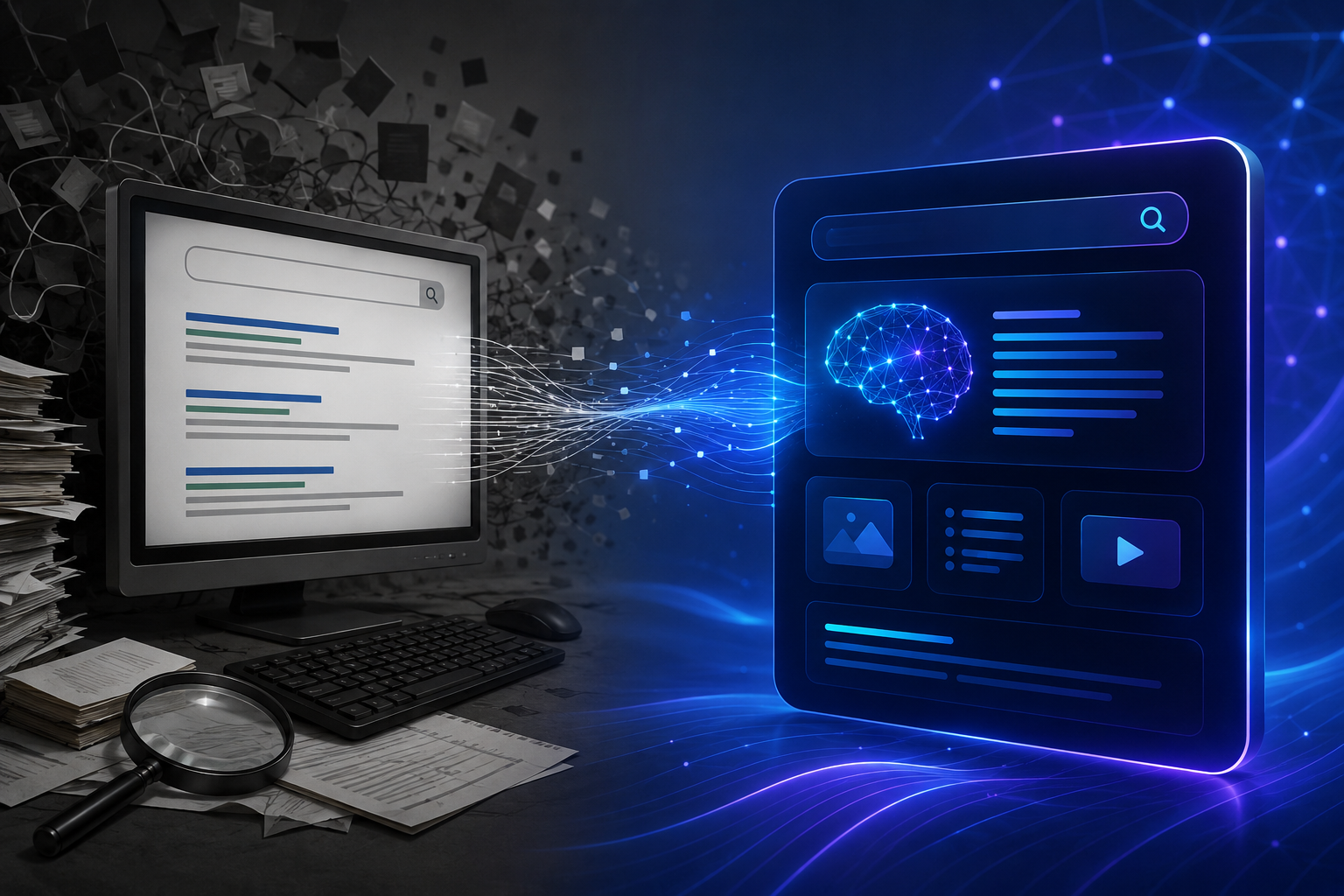
Traditional search returns a ranked list of links and lets the user choose where to click. AI search, whether inside Google’s AI Overviews, AI Mode, or a standalone assistant like ChatGPT or Perplexity, generates a direct answer and cites sources selectively within it.
According to SparkToro’s 2026 clickstream research, roughly 68% of Google searches in the US now end without a click to any website, up from around 45% a decade ago. When an AI Overview appears on the page, that zero-click rate climbs to approximately 83%.
The practical difference for website owners is this: ranking well no longer guarantees a visitor. Being cited or summarized well inside the answer itself is now a separate, parallel goal.
Why Traditional SEO Alone No Longer Works in 2026
Traditional SEO optimizes for one outcome: a top-10 ranking that earns a click. That goal still matters, but it has stopped being sufficient on its own.
Research from BrightEdge found that in late 2024, roughly 76% of AI Overview citations came from pages already ranking in the top 10 organically. By early 2026, that overlap had fallen to somewhere between 17% and 38% depending on methodology. In other words, ranking on page one is now a weak predictor of whether an AI system will actually cite your page.
At the same time, Ahrefs found that 99.2% of keywords triggering AI Overviews carry informational intent, and that longer, question-style queries trigger them far more often than short keyword searches. A site built only around short-tail keyword targeting is optimizing for a shrinking slice of the query landscape.
Traditional Search vs. AI Search: What Actually Changed
The table below summarizes the core differences a website now needs to account for.
| Factor | Traditional Search | AI Search |
|---|---|---|
| Primary goal | Top-10 ranking position | Citation inside the generated answer |
| Content format | Keyword-optimized long-form pages | Short, self-contained, answer-first sections |
| Ranking correlation | Direct: rank drives clicks | Weak: only 17-38% of citations come from top-10 pages |
| Technical priority | Backlinks, domain authority | Schema markup, structured data, crawlability |
| Success metric | Organic traffic, click-through rate | AI citations, brand mentions, impression share |
Five Website Changes Every Business Needs Before 2027
None of these require abandoning traditional SEO. They sit on top of it.
1. Structure Content So It Can Be Extracted, Not Just Read
AI systems pull short, self-contained passages out of a page to build an answer. A page written as one long, undifferentiated block of text gives an AI system nothing clean to extract.
Break content into clearly labeled sections, each answering one specific question in the first sentence. This is the same discipline behind a strong TL;DR summary or FAQ block, applied across the entire page rather than one section of it.
2. Add Schema Markup That Actually Matches Your Content
Structured data tells search engines and AI crawlers what your content means, not just what it says. Article, FAQPage, Product, and LocalBusiness schema are the highest-priority types for most sites.
A page with accurate schema is easier for both Google’s AI Overviews and third-party AI assistants to parse correctly. A page with missing or mismatched schema is often skipped in favor of a competitor’s page that is easier to interpret.
3. Fix the Technical Basics AI Crawlers Depend On
AI crawlers still need fast-loading, mobile-friendly, crawlable pages, and Core Web Vitals remain a baseline requirement, not a legacy metric. Content locked inside PDFs, JavaScript-rendered-only text, or slow-loading templates is frequently invisible to both traditional and AI-driven crawlers.
Any SEO agency in India working with mobile-heavy traffic should treat this as priority one, since a large share of Indian search traffic still runs on constrained mobile connections where slow pages fail before an AI system ever gets to evaluate the content.
4. Build Explicit E-E-A-T Signals Into Every Page
AI systems weigh author expertise, cited sources, and demonstrable experience more heavily than keyword density. A visible author bio, cited statistics with named sources, and clear evidence of first-hand experience all improve citation odds.
This is not a cosmetic addition. It directly affects whether an AI system treats your page as a trustworthy source worth quoting.
5. Publish for Both Google and the AI Assistants Your Buyers Actually Use
Google is not the only surface that matters anymore. Similarweb’s 2026 data shows AI-powered assistants like ChatGPT, Perplexity, Gemini, and Claude collectively growing referral share five times faster than they were a year earlier, even though the absolute share remains small for now.
Writing content that answers a question clearly, in plain language, with a citable statistic near the top, tends to perform well across all of these surfaces at once. There is no separate playbook needed for each individual AI assistant yet.
Why India-Based Businesses Can’t Treat This as a Western Problem
India is the world’s second-largest internet market, with roughly 900 million active users and a search landscape that runs close to 75% mobile. Google holds more than 97% of the Indian search market, among the highest concentration of any major economy.
That concentration means Google’s AI Overviews and AI Mode rollout will affect Indian search visibility just as directly as it affects the US and UK markets, if not more so, since there is little alternative search traffic to fall back on. At the same time, ChatGPT’s user base in India is already among the largest globally, alongside the US.
For any business working with an SEO agency in India, this means the optimization plan has to account for Google’s AI layer and for direct AI assistant visibility at the same time, not sequentially.
How to Choose the Right SEO Agency in India for AI-Ready Optimization
Look for a team that can show technical schema work, not just content calendars. Ask specifically how they measure AI Overview citations and AI assistant mentions, since standard rank-tracking tools do not capture this by default.
Key Takeaways
- Roughly 68% of Google searches in 2026 end without a click, and that rate rises to around 83% when an AI Overview appears.
- Ranking in the top 10 organically no longer reliably predicts AI Overview citation, since the overlap has dropped to as low as 17 to 38%.
- Structured, extractable content with clear answer-first sections performs better across both traditional and AI-driven search.
- Schema markup, Core Web Vitals, and E-E-A-T signals are now baseline requirements, not optional extras.
- India’s search market is heavily Google-concentrated and mobile-first, making it especially exposed to AI Overview and AI Mode changes.
- A capable SEO agency in India in 2026 should measure AI citation performance directly, not just keyword rankings.
Frequently Asked Questions
Does AI SEO replace traditional SEO?
No. AI SEO adds a parallel goal, citation inside AI-generated answers, on top of traditional ranking work. Both are necessary, and most of the technical foundation overlaps.
How long does it take to see results from AI SEO changes?
Featured snippet and AI Overview improvements often show up within the first quarter of dedicated work. Citation share inside standalone AI assistants like ChatGPT tends to build more slowly, typically over six to nine months.
Is India’s search market actually affected by AI Overviews yet?
Yes. AI Overviews are live across most major markets including India, and Google’s dominant share of Indian search traffic means changes to its results format affect Indian sites directly.
What is the single highest-priority change for a website in 2026?
Fixing extractable content structure and schema markup together, since both directly affect whether an AI system can parse and cite a page correctly.
Do small businesses need to worry about AI SEO, or only large brands?
Small businesses are affected as much as large ones, since AI Overviews trigger on informational queries regardless of business size. Local and transactional queries currently see this less, which still gives smaller local businesses some room to compete on traditional SEO.
Conclusion
The shift from traditional search to AI-driven search is not a future event to plan for later. It is already the majority behavior in 2026, and it is accelerating. Websites that only optimize for a ranking position are optimizing for a shrinking share of how people actually find answers now.
The businesses adapting fastest are treating AI citation and traditional ranking as two connected goals, built on the same technical foundation of fast, well-structured, clearly authored content.
Working with an experienced SEO agency in India that measures both traditional rankings and AI citations is the fastest way to close that gap before competitors do.
