
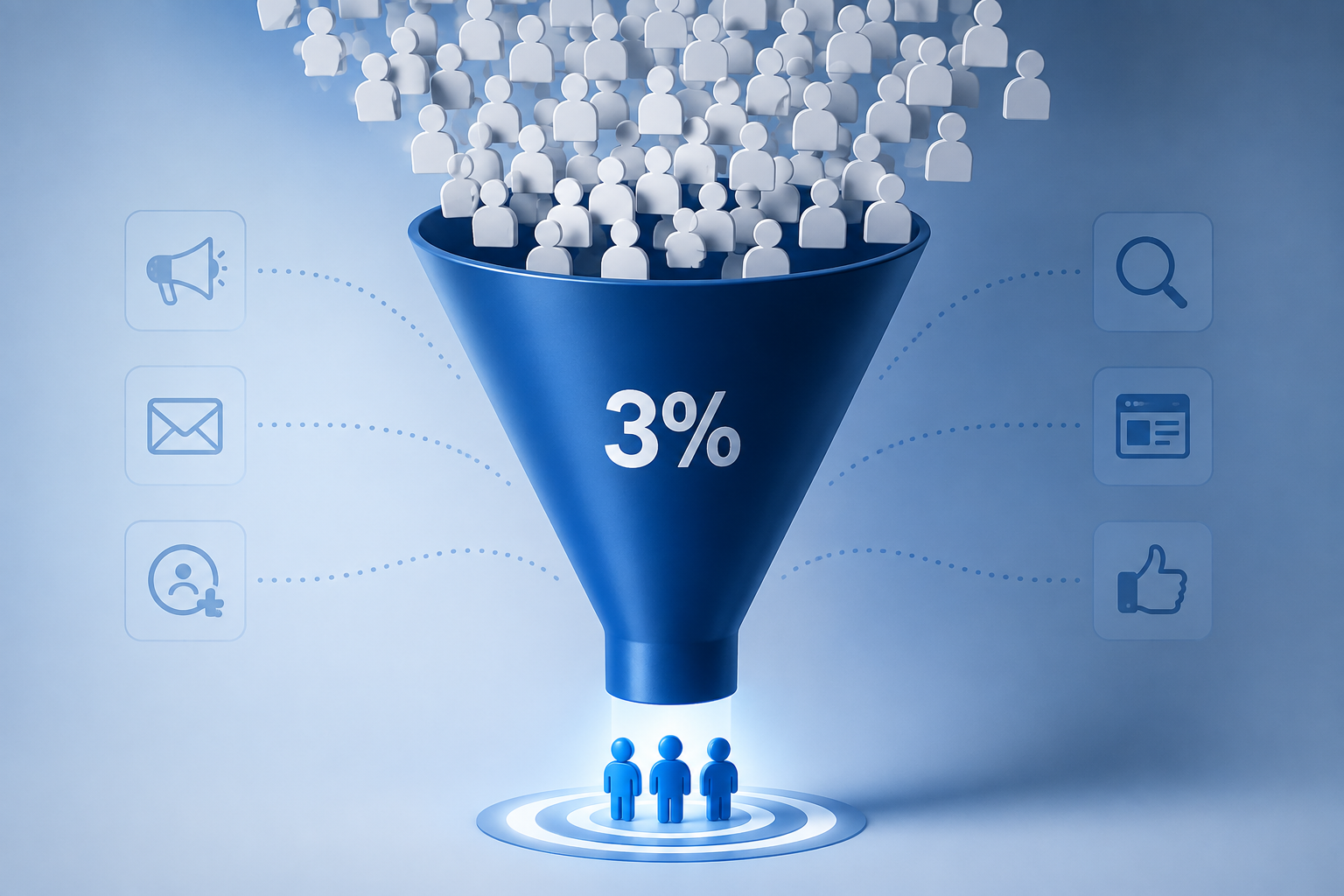
The average website converts roughly 2.35% of its visitors, and first-time visitors specifically convert at closer to 1 to 2%, compared to 4.5 to 6% for people who’ve been there before. That means the overwhelming majority of everyone a business’s digital marketing successfully reaches, somewhere between 94 and 99 out of every 100 people, leaves without buying, booking, or filling out a form.
The average website converts roughly 2.35% of visitors, meaning around 97 out of every 100 people a business’s digital marketing reaches leave without converting. Most small business digital marketing budgets are built almost entirely around reaching more new people, with little to no spend on the three systems that re-engage that unconverted majority: retargeting ads, email or SMS capture, and a planned follow-up sequence. Returning visitors convert at two to three times the rate of first-time visitors, making this the highest-return gap most digital marketing budgets are leaving unaddressed.
Most small business digital marketing budgets are built almost entirely around the opposite priority: reaching more new people. Another ad campaign, another boosted post, another round of cold outreach. Very little budget or process goes toward the much larger group that’s already been reached once and simply hasn’t converted yet, even though that group is statistically far more likely to convert than a brand new stranger.
This isn’t a hypothetical inefficiency. It’s the single largest, most consistently overlooked opportunity sitting inside digital marketing budgets that otherwise look perfectly reasonable on paper. A related pattern shows up in web conversion work too: in our case study on how we lifted website conversions 42% through frontend-only changes, the biggest gains came from fixing what happened to visitors who were already on the page, not from driving more traffic to it. The same logic applies to the digital marketing budget sitting behind that traffic.
Why “Reach More People” Is the Default, Even Though It’s the Wrong First Move
Reaching new people feels like the obvious lever to pull in digital marketing, because it’s the most visible one. A bigger ad spend produces a bigger reach number, and a bigger reach number feels like progress, even when the conversion rate on that new traffic stays exactly where it’s always been.
The 97% left over from every campaign isn’t a failure of the campaign. It’s the expected, well-documented outcome of how buying decisions actually work, since most people need multiple exposures to a business before they’re ready to act, not one. Contentsquare’s 2026 benchmark analysis of over 46 billion sessions puts the global average website conversion rate at 2.35%, meaning 97 out of every 100 visitors leave without taking action, which means treating each ad or post as a one-shot attempt to convert a total stranger sets the bar for digital marketing success unrealistically high from the start.
Where This Group Actually Goes
Nearly every one of these unconverted visitors leaves a trace that most small business digital marketing setups never capture. A website visit without a retargeting pixel in place is a visitor a business can never intentionally reach again. A social media engagement without a lead capture mechanism is a moment of interest with no way to follow up. An email that was opened but not acted on, then never followed by a second email, is a conversation that ended after one sentence.
None of this requires more traffic. It requires a digital marketing system that treats an unconverted visitor as someone still in the process of deciding, not someone who said no.
The Three Digital Marketing Systems Most Small Businesses Are Missing
Retargeting Ads Aimed at Site Visitors, Not Just Cold Audiences
A retargeting pixel installed on a website lets a business show ads specifically to people who’ve already visited, at a fraction of the cost of reaching a cold audience of strangers. Many small business digital marketing accounts run exclusively on cold, interest-based targeting and never build or use a retargeting audience at all, which means every visitor who doesn’t convert on the first visit simply disappears from the business’s reach entirely, as if the money spent reaching them in the first place bought nothing beyond that single, brief visit.
Retargeting audiences also tend to be small relative to cold audiences, which keeps the cost of reaching them low even on a limited budget, making this one of the more cost-efficient additions available to a digital marketing program that’s currently spending exclusively on cold reach.
Email or SMS Capture Before the Visitor Leaves
A visitor who doesn’t buy but provides an email or phone number in exchange for something useful, a discount, a guide, a consultation booking, stays reachable through a channel the business fully controls. Without a specific capture mechanism in place, that same visitor leaves with nothing exchanged, and the business has no way to reach them again unless they happen to come back on their own, which is precisely the outcome most unconverted visitors never do.
Unlike a retargeting audience, which depends on an ad platform’s algorithm and can shift or shrink over time, an email or SMS list is an owned digital marketing asset the business controls directly, regardless of what happens to any individual ad platform’s policies or costs.
A Follow-Up Sequence, Not a Single Message
A single email or a single retargeting ad is not a follow-up system, it’s one attempt. A short, planned sequence, three to five messages spaced over a couple of weeks, each addressing a different hesitation a buyer might have, converts a meaningfully higher share of that audience than a single message ever will in most digital marketing programs, simply because most buying decisions aren’t made on the first exposure.
The content of that sequence matters as much as its existence. A sequence that repeats the same offer five times in five days reads as pressure, while one that answers a new, specific concern in each message, price, trust, timing, alternatives, reads as genuinely useful follow-up rather than repetition for its own sake.
First Contact vs. Warm Follow-Up, Side by Side
The table below summarizes the practical difference between treating every visitor as a one-time event versus building a system around the 97% who don’t convert immediately.
| Factor | Cold-Only Approach | Warm Follow-Up System |
|---|---|---|
| Typical conversion rate | 1-2% on first-time visitors | 4.5-6% on returning visitors |
| Cost to reach again | Full cold-acquisition cost each time | Fraction of cost via retargeting |
| Ownership of the audience | None; platform-dependent reach only | Owned via email/SMS list |
| What happens after one exposure | Visitor is effectively lost | Visitor enters a planned sequence |
What Fixing This Digital Marketing Gap Actually Requires
None of these three systems require a bigger digital marketing budget. They require redirecting a portion of the budget and attention currently spent exclusively on cold acquisition toward the audience that’s already been reached once, since that audience converts at two to three times the rate of a brand new visitor by nearly every published benchmark.
This is the part of digital marketing that’s easy to skip because it’s less visible than a new campaign launch, but it’s also the part most directly responsible for whether the same digital marketing spend produces a proportionally larger return over time, rather than resetting to zero with every new campaign.
Key Takeaways
- The average website converts roughly 2.35% of visitors, and first-time visitors convert at closer to 1 to 2%, meaning the large majority of everyone reached doesn’t convert on the first exposure.
- Most small business digital marketing budgets are built almost entirely around reaching new people, with little to no deliberate spend on re-engaging people already reached.
- Retargeting ads, email or SMS capture, and a planned follow-up sequence are the three most commonly missing digital marketing systems for reaching that unconverted majority.
- Returning visitors convert at roughly two to three times the rate of first-time visitors, making this audience one of the highest-return segments available without any additional ad spend on new reach.
- Fixing this doesn’t require a bigger digital marketing budget, it requires redirecting part of an existing budget toward the audience that’s already shown interest once.
Frequently Asked Questions
Does this apply to service businesses, or only e-commerce?
It applies to both. A service business loses the same kind of unconverted inquiry or website visitor a retail store loses an unconverted shopper, and the same three systems, retargeting, capture, and follow-up, apply regardless of what’s being sold.
How long should a follow-up sequence run before giving up on a lead?
Two to three weeks with three to five messages is a reasonable starting structure for most small businesses, though this varies by how considered the purchase decision typically is. A low-cost, low-commitment purchase usually needs a shorter sequence than a high-cost service decision.
Isn’t retargeting the same as being annoying or pushy?
Not when it’s built around genuinely useful follow-up, like answering a common hesitation or offering something new, rather than simply repeating the same ad. The distinction is between a system that adds value at each touch and one that just repeats the same message with no new reason to reconsider.
What’s the fastest system to set up first?
A retargeting pixel is typically the fastest, since it can often be installed in under an hour and immediately starts building an audience, even before any specific retargeting campaign is built around it.
Do these three systems need to be built all at once?
No. Each one adds value independently, so most small businesses see the best results starting with whichever one is currently completely missing, rather than trying to build all three simultaneously.
How do I know if my business already has this problem?
Check whether a retargeting pixel is actually installed and being used in an active campaign, whether there’s any offer capturing contact details from visitors who don’t convert, and whether a lead who goes quiet ever receives more than one follow-up message. If any of those three checks comes back empty, that’s the specific gap costing the most.
Conclusion
A business doesn’t have a traffic problem nearly as often as it has a follow-up problem. The 97% who don’t convert on the first exposure aren’t gone, they’re simply unreached a second time, and that’s a fixable gap in the marketing system rather than an inevitable cost of doing business.
Building retargeting, capture, and follow-up into a marketing program is exactly the kind of integrated work a properly run digital marketing strategy should include from the start. The businesses that fix this gap don’t necessarily spend more on marketing, they simply stop paying to reach the same 97% of people over and over without ever following up with any of them.
