
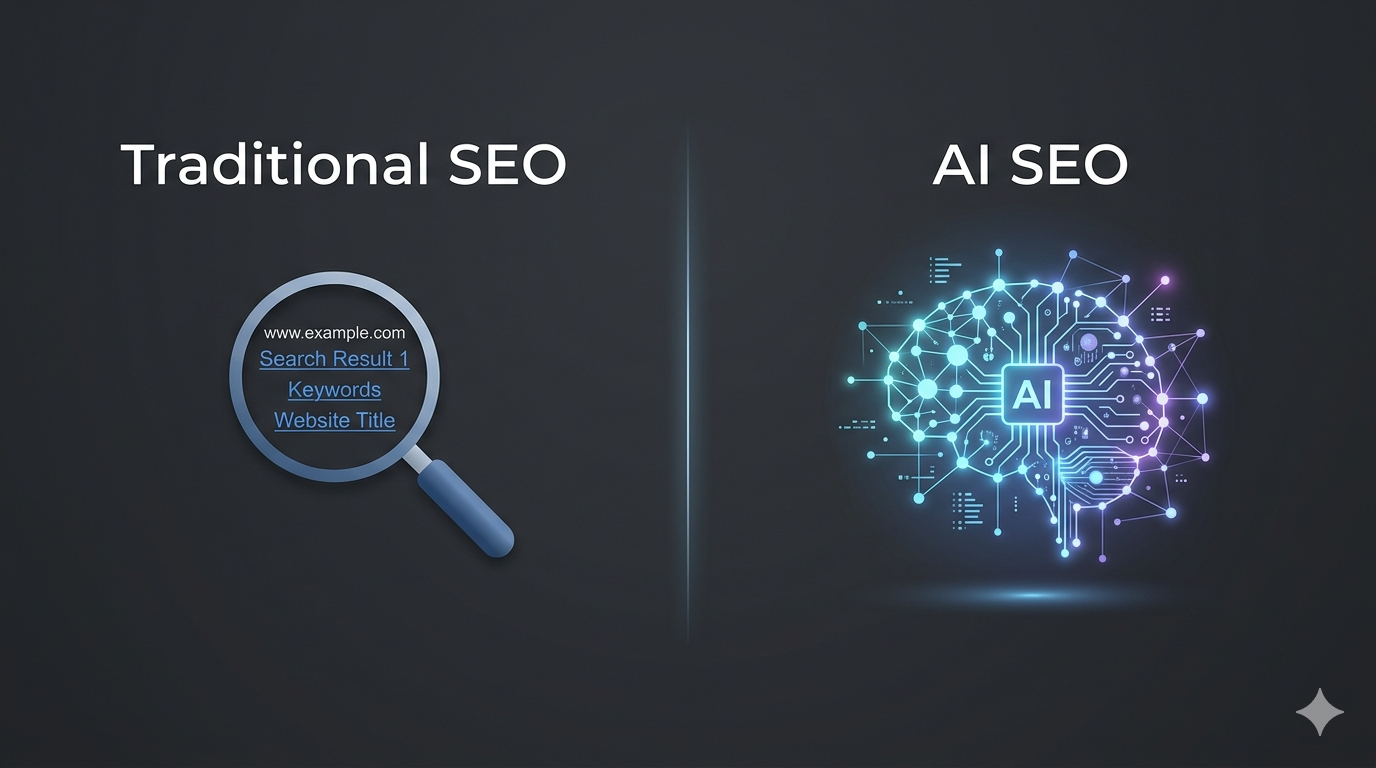
Traditional SEO vs. AI SEO
Your rankings are fine. Your leads are disappearing. Here’s why.
You’re on page one of Google. You’ve done the keyword research. Your blogs are live. Your backlinks look decent. And yet — inquiries are slowing down. Traffic looks flat or is quietly declining. Something doesn’t feel right.
Over 60% of all Google searches and 77% of mobile searches now result in zero clicks — users find the answer directly in Google’s AI Overview and never visit any website at all. This isn’t a temporary blip. This has permanently changed how visibility is defined, measured, and optimised for.
Welcome to the era of AI SEO — and if your Indian business hasn’t made the shift yet, this guide is for you.
What is Traditional SEO? (And Why It Was the Gold Standard)
Traditional SEO is the foundation of search engine optimisation. It relies heavily on human expertise, manual analysis, and ongoing adjustments to improve a website’s search rankings.
For over two decades, the formula was simple — and it worked:
-
Research the right keywords
-
Write content around them
-
Earn backlinks from other websites
-
Fix your technical SEO — page speed, mobile, sitemaps
-
Climb the Google rankings and collect traffic
You researched keywords, earned backlinks, fixed your page speed, and climbed the blue links. Google was the gatekeeper. The algorithm was the law. For most Indian businesses from 2005 to 2022, this approach delivered real results. It still forms the foundation of search visibility.
But the rules have changed — fundamentally.
What is AI SEO? (The New Game in Town)
AI SEO is an evolution of traditional SEO designed for AI-driven search systems. It focuses on optimising content so that search engines powered by machine learning and LLMs can understand, extract, and recommend it.
Instead of trying to rank in a list of blue links, AI SEO is about becoming the source that AI systems trust, quote, and recommend when someone asks a question.
How search behaviour has shifted
That’s the difference. And that’s why AI SEO matters for your business today.
Free Strategy Call
Ready to Grow with AI-Powered SEO?
Let’s build a custom SEO strategy for your business. No commitments – just actionable insights.
No Obligations
Reply in 2 Hrs
Your information stays private & secure
The Indian Search Landscape Has Shifted — Faster Than You Think
India isn’t just experiencing this AI search shift — it’s one of the fastest-moving markets in the world.
And the zero-click picture is even more striking:
Traditional SEO vs. AI SEO: A Head-to-Head Comparison
Here’s where the two approaches fundamentally diverge:
| Category | 🔵 Traditional SEO | 🤖 AI SEO |
|---|---|---|
| Primary Goal | Rank in Google’s blue-link results | Get cited & recommended by AI systems |
| Keyword Approach | Target specific keywords & variations | Understand meaning, relationships & intent behind queries |
| Content Focus | Word count, keyword density & backlinks | Clarity, accuracy, usefulness & structured answers |
| Optimisation For | Google’s crawlers & ranking algorithm | LLMs: ChatGPT, Perplexity, Gemini, Copilot |
| Trend Response | Reacts to trends after they emerge | Predicts trends using AI-driven signals |
| Content Structure | Long-form, keyword-rich paragraphs | Answer-first, FAQ blocks, schema markup |
| Link Building | Backlinks to your own site | Brand mentions across trusted third-party platforms |
| KPIs Tracked | Keyword rankings, organic traffic | AI citation rate, share-of-voice in AI, AI referral traffic |
| Schema / Structured Data | Helpful but optional | Essential — FAQ, HowTo, Organisation schema required |
| Local / India Focus | Location pages & local keywords | India-specific content that AI systems recognise as authoritative |
| Time to Results | 3–12 months for keyword rankings | 4–8 weeks for initial AI citation visibility |
| Traffic Source | Google search (blue links) | Google AI Overviews + ChatGPT + Perplexity + Bing Copilot |
Free Strategy Call
Ready to Grow with AI-Powered SEO?
Let’s build a custom SEO strategy for your business. No commitments – just actionable insights.
No Obligations
Reply in 2 Hrs
Your information stays private & secure
The 5 Biggest Changes You Need to Know About
1. You Can Rank #1 and Still Be Invisible
This is the hardest pill to swallow for Indian business owners who’ve invested years in traditional SEO.
The AI and the Google algorithm are increasingly making independent decisions. Your Google rank no longer guarantees your AI visibility.
2. The Click-Through Collapse is Real
Individual websites experience an average 34.5% CTR reduction when AI Overviews appear for their keywords. Here’s the flip side most people miss: being cited in AI Overviews increases organic CTR by 35% compared to not being cited.
3. AI Systems Don’t Follow Google’s Rules
AI search doesn’t follow the old SEO playbook. It doesn’t pull from your brand’s site, it doesn’t care about your meta tags. AI pulls signals across the web.
When multiple trusted domains mention your brand, the AI sees a pattern — and that’s how it chooses the brands it recommends. Your strategy can no longer be limited to your own website. You need mentions, citations, and references across third-party platforms, forums, review sites, and industry publications.
4. Keyword Stuffing is Dead. Answer-First Wins.
LLMs grab concise, structured information — not fluff. Your content has to be recommendation-ready from the first line. AI assistants don’t dig for buried details — they surface the clearest, most directly usable answers they can find.
Every section of your blog, service page, or FAQ should answer a specific question directly and confidently — not pad word counts.
5. India Has a First-Mover Advantage Right Now
🚀 The Opportunity Most Indian Businesses Haven’t Heard About
The volume of well-structured, authoritative content about India-specific business topics — GST compliance, PLI scheme implications, regional consumer behaviour — is significantly lower than equivalent Western content. Competition for AI citations on Indian topics is still very low. The brands that invest in AI SEO today will own their categories in AI search results for the next 3–5 years.
Most Indian SMEs are still behind that curve — which is exactly why the opportunity is significant right now.
Does Traditional SEO Still Matter? (The Honest Answer)
Yes — absolutely. Traditional SEO helps you rank in search results, while AI SEO helps your business be understood and recommended inside AI-generated answers. In 2026, serious brands need both.
Think of it as three lanes on a highway:
Google blue links — still the majority of traffic. Non-negotiable.
Lane 2 — GEO
Being cited inside AI-generated answers (Google AI Overviews, Perplexity).
Lane 3 — AEO
Being directly named & recommended by AI systems like ChatGPT & Copilot.
Most businesses are only in one lane. The ones winning in 2026 are in all three simultaneously.
What Needs to Change in Your SEO Strategy — Right Now
Here’s what an AI-ready SEO strategy looks like for Indian businesses in 2026:
-
Restructure Your Content for AI Extraction
Focus on clarity, entity trust, structured answers, schema, citations, FAQs, and content blocks that are easy for AI systems to quote or summarise. Less keyword stuffing, more making your brand easy to understand.
-
Add Schema Markup Across Your Website
FAQ schema, HowTo schema, Organisation schema — these are now table stakes for AI search visibility. Page speed and mobile responsiveness are no longer optional either.
-
Build Off-Site Brand Authority
LLMs lean heavily on domains they recognise as credible. You need great content on your own site AND mentions across platforms the AI trusts — forums, reviews, industry publications.
-
Track AI-Specific Metrics
Traditional keyword rank tracking won’t tell you how you’re performing in AI. Track:- How often your brand is cited by ChatGPT and Perplexity
- Your AI share-of-voice vs. competitors
- Traffic from AI referral sources in Google Analytics 4
- Engagement depth and content relevance scores
-
Localise for India-Specific Queries
Ensure your content is accessible, culturally relevant, and optimised for regional search behaviour. India’s diverse digital environment demands India-first content strategy.
The Bottom Line for Indian Businesses
In 2026, search engine optimisation is no longer a game of keywords and backlinks alone. It has become a living system shaped by artificial intelligence, user intent, behavioural data, and real-time context.
Traditional SEO alone is not enough — but it is still necessary. AI SEO is what turns visibility into dominance in an AI-driven search ecosystem. The Indian businesses that act now will build a compounding AI search presence that their competitors — still chasing blue link rankings — won’t be able to catch up to easily.
Ready to Make the Switch to AI SEO?
At Kinsh Technologies, we go beyond page one. We optimise your content to appear in Google AI Overviews, ChatGPT responses, Perplexity answers, and Bing Copilot — one strategy, everywhere your customers search.
Get Your Free AI Visibility Audit →
No commitment. Just a clear picture of where you stand in the AI search world.
Frequently Asked Questions
Yes. Traditional SEO provides the foundation. AI SEO builds on top of it. You need both in 2026 — the goal is to be visible in Google search results AND in AI-generated answers.
Traditional SEO focuses on ranking in a list of search results. AI SEO focuses on getting your brand cited and recommended by AI systems like ChatGPT, Perplexity, and Google AI Overviews when users ask conversational questions.
Initial AI citation visibility typically begins within 4–8 weeks. Comprehensive AI search presence takes 3–6 months of consistent effort.
Absolutely — in fact, small Indian businesses have a first-mover advantage right now because competition for AI citations on India-specific topics is still very low compared to Western markets.
Start with an AI visibility audit — understand which queries your brand appears in (or doesn’t) across ChatGPT, Perplexity, and Google AI Overviews. That gap analysis becomes your roadmap.
