
The best AI SEO agency combines traditional search expertise with genuine AI search optimisation skills — covering Google AI Overviews, LLM visibility (ChatGPT, Perplexity, Gemini), and Answer Engine Optimisation (AEO). To choose the right one, evaluate their technical depth, content methodology, AEO track record, and whether they treat AI search as a core service rather than a bolt-on.
What Is an AI SEO Agency?
An AI SEO agency is a digital marketing firm that optimises websites for both traditional search engines and AI-powered discovery platforms. This includes Google Search, Google AI Overviews, ChatGPT, Perplexity, Claude, Gemini, and Bing Copilot.
The term covers two distinct capabilities. First, using AI tools internally to work faster and smarter — automating audits, generating content at scale, analysing crawl data. Second, and far more importantly, optimising content so that AI systems cite, surface, and recommend a client’s business in response to user queries.
The second capability is what separates a genuine AI SEO agency from a traditional one with a few new tools.
Why AI SEO Is Different from Traditional SEO
Traditional SEO focuses on ranking a web page on Google’s first page. The goal is a blue link a user can click. AI SEO has a fundamentally different objective: getting your brand cited, referenced, or recommended inside an AI-generated answer — before the user ever clicks anything.
According to BrightEdge research, AI Overviews now appear for roughly 30% of all Google searches, and that figure continues to rise. Gartner projects that search engine volume will drop 25% by 2026 as consumers shift to AI-powered interfaces. This is not a marginal trend — it is a structural change in how people discover businesses.
Answer Engine Optimisation (AEO) — the practice of structuring content so AI retrieval systems extract and cite it directly — requires a different skill set than traditional on-page SEO. It involves content architecture, entity mapping, schema implementation, semantic depth, and an understanding of how large language models evaluate source trustworthiness.
A business that only invests in traditional SEO is optimising for a channel that is shrinking. The best AI SEO agencies optimise for both — protecting existing Google rankings while building visibility in the AI layer on top.
What the Best AI SEO Agencies Actually Do
The strongest AI SEO agencies operate across three layers simultaneously.
Technical SEO Foundation
No AI search strategy works without a clean technical base. This means fast page speeds, structured data (schema markup), accessible crawling by AI bots (GPTBot, ClaudeBot, PerplexityBot), a properly implemented llms.txt file, and solid internal linking architecture.
Many agencies neglect to confirm that AI crawlers are not blocked in robots.txt. At Kinsh Technologies, we see this in roughly 60% of first-time client audits — AI platforms simply cannot index the site, rendering any AEO effort pointless.
Content Built for AI Extraction
Top AI SEO agencies write content that serves two readers at once: a human visitor and an AI retrieval system. This means answer-first paragraph structures, TL;DR summary capsules, FAQ sections, comparison tables, and branded insight statements that give AI models a clear, attributable source to cite.
According to a 2024 analysis by Search Engine Land, pages with structured FAQs and short, direct answer paragraphs appear in AI Overviews at 3x the rate of long-form prose-heavy pages. The best agencies build this into every piece of content they produce.
GEO and LLM Visibility Strategy
Generative Engine Optimisation (GEO) — optimising specifically for how large language models represent a brand in generated answers — is the newest and most specialised layer. It involves building topical authority, earning citations from high-trust sources, and ensuring consistent brand signals across the web so that AI models develop a reliable representation of the business.
The best AI SEO agencies have a clear GEO methodology. If an agency cannot explain how they improve a client’s presence inside ChatGPT or Perplexity answers specifically, they are not an AI SEO agency — they are a traditional SEO agency with updated marketing copy.
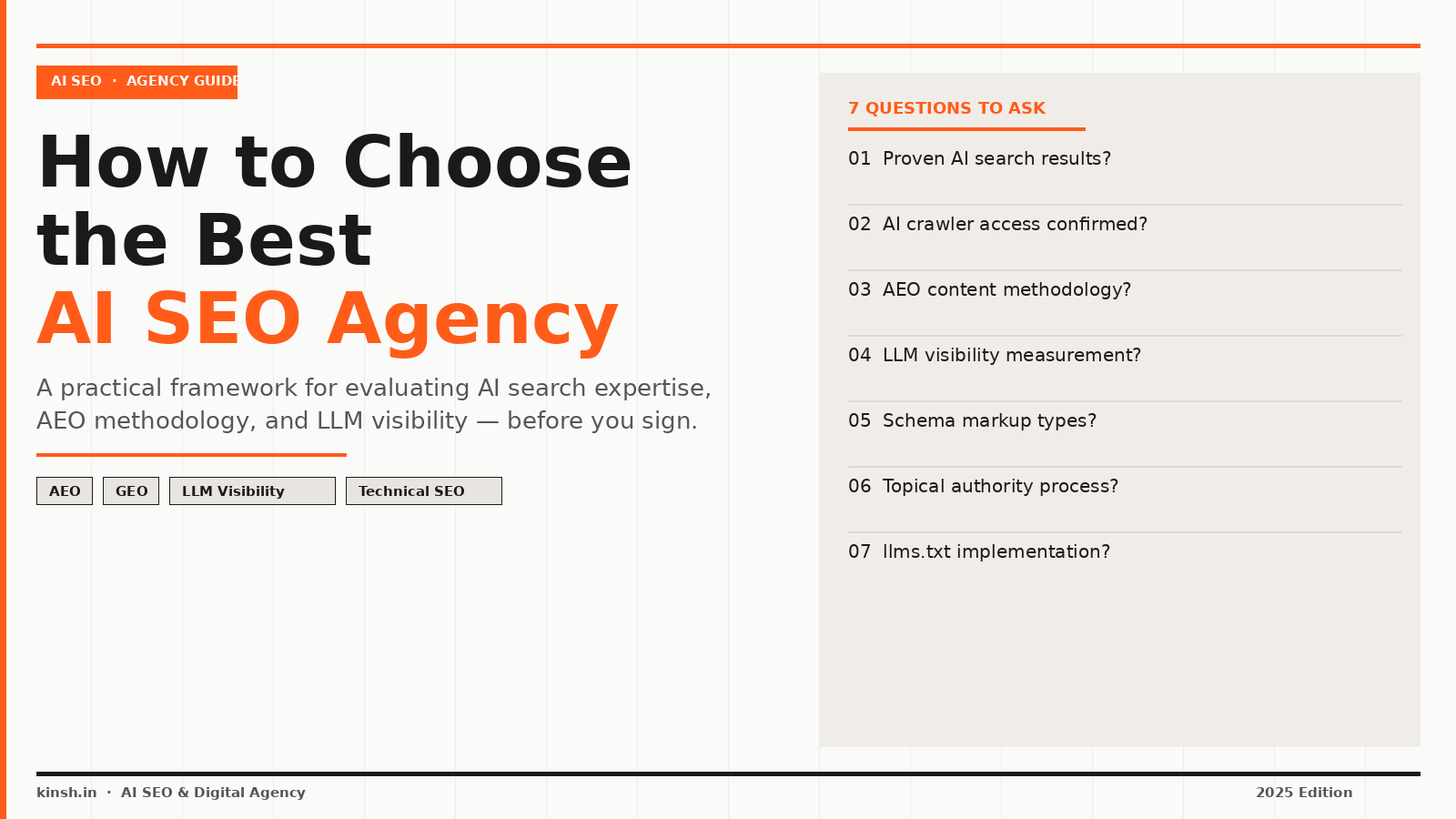
7 Questions to Ask Before You Hire an AI SEO Agency
Before signing with any AI SEO agency, put these questions directly to their team.
1. Can you show me a client whose brand appears in AI-generated answers — and how you achieved that?
Look for specific examples: a screenshot of a Perplexity citation, a documented increase in AI Overview appearances. Vague claims are a signal to keep looking.
2. Do you audit robots.txt to confirm AI crawlers are permitted?
This is table stakes. If they look uncertain, they are not running proper AI SEO audits.
3. What is your content structure methodology for AEO?
They should mention answer-first writing, TL;DR capsules, FAQPage schema, and structured data. A blank stare or a generic answer about ‘quality content’ is a red flag.
4. How do you measure LLM visibility — not just Google rankings?
Traditional rank tracking tools don’t capture AI Overview appearances or Perplexity citations. The agency should have a specific monitoring approach for this.
5. Do you implement schema markup — and which types, specifically?
The answer should include Article, FAQPage, Speakable, and BreadcrumbList at minimum. HowTo schema for tutorial content. If they only mention basic meta tags, they are behind.
6. What is your process for building topical authority?
Strong AI SEO agencies build content clusters — a pillar page supported by multiple satellite posts — that signal deep expertise to both Google and LLMs. Ask to see a content map.
7. Do you have an llms.txt implementation process?
This emerging standard helps AI systems understand a site’s structure and key content. Forward-looking agencies already include it in their technical onboarding.
Red Flags to Watch Out For
Not every agency that calls itself an AI SEO agency has earned the title. Watch for these warning signs.
They lead with AI tools, not AI strategy.
Using ChatGPT to write blog posts is not AI SEO. Any agency that positions their AI tool stack as their primary differentiator is selling software efficiency, not search visibility.
They cannot distinguish between AEO, GEO, and traditional SEO.
These are distinct disciplines with different techniques. Conflating them is a sign of surface-level knowledge.
They promise guaranteed rankings.
No ethical agency — AI or traditional — can guarantee specific search positions. Anyone who does is either lying or selling you something that will eventually get your site penalised.
Their own site doesn’t appear in AI search results.
Ask a question in Perplexity or ChatGPT that the agency should be answering. If they don’t appear, ask why. A cobbler’s children having no shoes is a tired excuse in 2025.
They have no structured data on their own site.
Run any candidate agency’s homepage through Google’s Rich Results Test. If they cannot implement schema on their own site, they will not implement it properly on yours.
How to Compare AI SEO Agencies: A Framework
Use this table to score potential AI SEO agencies across the dimensions that matter.
| Evaluation Criteria | What to Look For | Weight |
|---|---|---|
| Technical SEO depth | Schema, Core Web Vitals, crawl accessibility, llms.txt | High |
| AEO content methodology | Answer-first structure, FAQs, TL;DR capsules, entity coverage | High |
| GEO / LLM strategy | Clear process for ChatGPT, Perplexity, Gemini visibility | High |
| Proven client results | AI Overview appearances, LLM citations, case studies | High |
| Reporting & measurement | AI search monitoring, not just rank tracking | Medium |
| Sector experience | Familiarity with your industry’s search landscape | Medium |
| Pricing transparency | Clear scope, no vague retainer terms | Medium |
| Team credentials | Named team members, verifiable expertise | Low–Medium |
Score each agency out of 10 on the first four criteria. Any agency below 6 on technical SEO depth or AEO methodology should be removed from consideration, regardless of price or pitch quality.
What to Expect from a Proper AI SEO Engagement
A well-structured AI SEO engagement follows a clear sequence.
Month 1: Audit and Foundation
A thorough technical audit covering crawl accessibility, schema gaps, page speed, robots.txt configuration, and current AI search visibility. This should include a baseline measurement of how often the brand appears in AI Overviews and AI-generated answers.
Months 2–3: Content Architecture
Building or restructuring content around topical clusters. Implementing FAQPage and Article schema. Adding TL;DR capsules to existing high-value pages. Launching new AEO-optimised content targeted at high-intent queries.
Months 3–6: Authority Building and GEO
Earning citations from authoritative sources, building the external signal profile that LLMs use to evaluate brand trustworthiness, and refining content based on what AI systems are actually citing.
According to Semrush’s State of Search report, most SEO improvements take three to six months to register measurable results in traditional search. AI search visibility can move faster — particularly for brands in niche verticals with low existing AI coverage — but sustained results require the same patience applied to any authority-building programme.
In our experience at Kinsh Technologies, clients who commit to at least a six-month engagement see significantly stronger LLM citation rates than those who treat AI SEO as a one-time audit.
Frequently Asked Questions (FAQs)
What is the difference between an AI SEO agency and a traditional SEO agency?
A traditional SEO agency focuses on Google rankings — the blue links users click in standard search results. An AI SEO agency does that and also optimises for visibility inside AI-generated answers from platforms like ChatGPT, Perplexity, Google AI Overviews, and Gemini. The techniques required are different: structured content, schema markup, entity coverage, and LLM-readable formatting are central to AI SEO but rarely prioritised in traditional SEO.
How do I know if an AI SEO agency is legitimate?
Ask them to show you documented examples of client brands appearing in AI-generated answers, and explain the specific techniques used to achieve that. Ask them to run their own site through a schema validator and show you their robots.txt. Legitimate AI SEO agencies can demonstrate their methodology on their own web presence, not just describe it in a deck.
How much does an AI SEO agency cost?
Pricing varies significantly by market, agency size, and scope. In the UK and US markets, monthly retainers for a specialist AI SEO agency typically range from £1,500 to £8,000 per month for SMBs, depending on the volume of content, technical complexity, and the number of target keywords and AI channels. Project-based engagements for audits or content restructures can range from £500 to £5,000.
How long does AI SEO take to show results?
Technical fixes — schema implementation, robots.txt correction, page speed — can improve AI crawlability within weeks. Content-driven AEO results typically appear within two to four months. Building sustained LLM visibility (the brand being consistently cited in AI-generated answers) is a six-to-twelve month programme for most businesses. Anyone promising results in weeks is overpromising.
Should a small business hire an AI SEO agency?
Yes, particularly if customers use conversational search or AI tools to research purchasing decisions — which now includes most B2B and professional services buyers. Smaller businesses in niche verticals often see faster AI visibility gains because competition for LLM citations is lower than in broad consumer markets. The key is choosing an agency with a realistic scope for your budget, not a full-enterprise retainer when a focused three-month engagement would deliver more value.
What is GEO and how is it different from AEO?
Answer Engine Optimisation (AEO) focuses on structuring content so AI systems extract and use it in generated answers. Generative Engine Optimisation (GEO) is a broader discipline focused on how large language models represent and recommend a brand across all generated content — not just direct answers to specific queries. GEO encompasses brand entity signals, external citation profiles, and the consistency of brand information across the web. The best AI SEO agencies address both.
Can I do AI SEO in-house rather than hiring an agency?
In-house is possible if you have a team member with genuine technical SEO depth, content strategy experience, and current knowledge of how LLMs evaluate sources. In practice, most in-house marketing teams are better positioned to execute content at volume once a specialist agency has established the architecture and methodology. A hybrid model — agency strategy, in-house execution — often produces the best results per pound spent.
Conclusion
Choosing the best AI SEO agency comes down to one core question: can they prove their methodology works in AI search, not just traditional Google rankings? The agencies worth hiring have a documented process for AEO content, a technical checklist that includes schema and AI crawler accessibility, and real examples of client brands appearing inside AI-generated answers.
The shift toward AI-powered search is accelerating. Businesses that establish AI search visibility now will hold a significant advantage over those that wait until the channel becomes too competitive to enter cheaply. The right AI SEO agency is not the one with the most polished pitch deck — it is the one that treats AI search as a core discipline, not a marketing label.
If you are ready to audit your current AI search visibility and build a strategy that works across Google, ChatGPT, Perplexity, and beyond, get in touch with the Kinsh Technologies team.
