
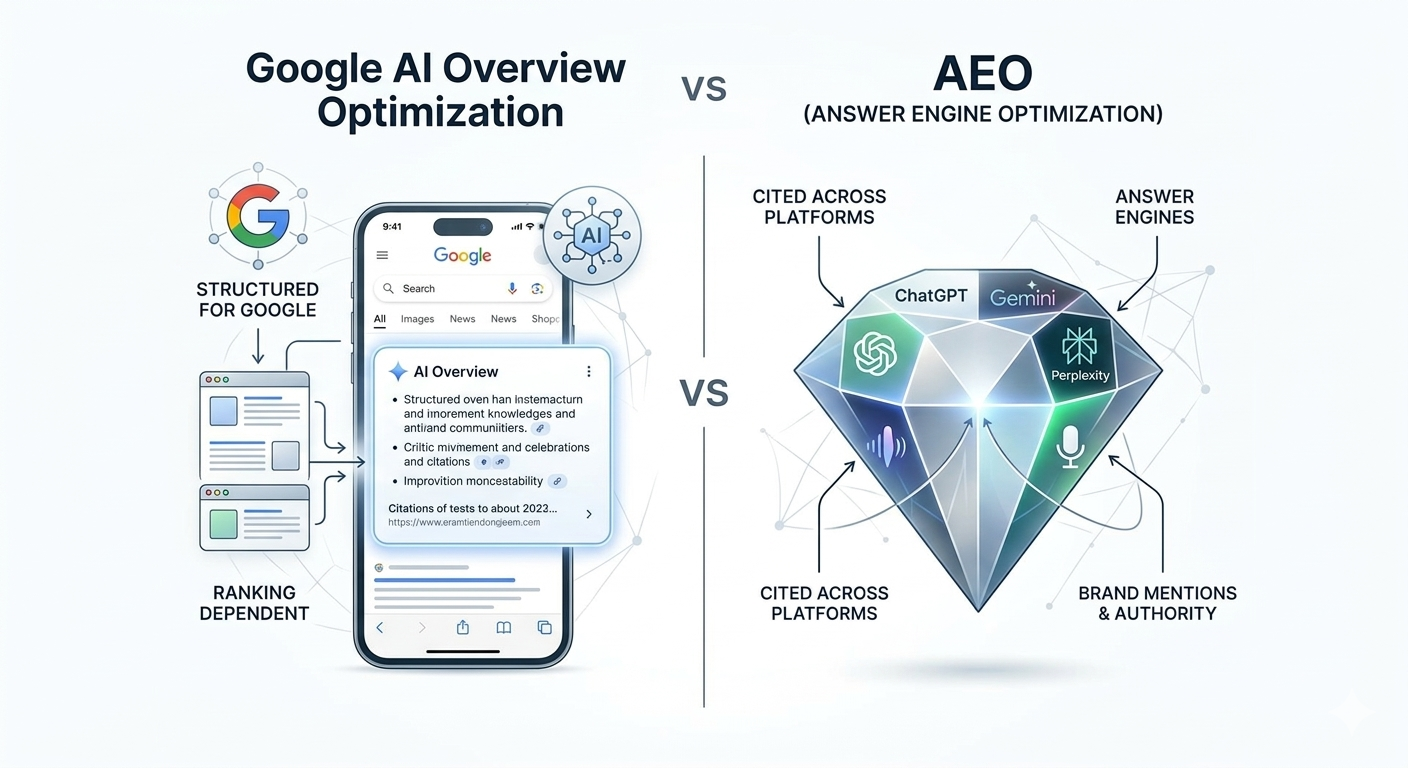
Understanding the difference between Google AI Overview Optimization and Answer Engine Optimization (AEO) is critical for any digital marketer in 2026. This guide breaks down exactly how Google AI Overview Optimization works, how it differs from broader AEO, and what strategies you need to win in both.
Answer Engine Optimization (AEO) focuses on getting your brand cited across multiple AI platforms including ChatGPT, Perplexity, Google AI Overviews, Gemini, and other AI search engines. Google AI Overviews optimization specifically targets Google’s AI-generated summaries that appear at the top of search results. While Google AI Overviews optimization is a subset of AEO with heavy reliance on traditional SEO ranking factors, AEO takes a broader, platform-agnostic approach that prioritizes extractability, citation-readiness, and brand mentions across the entire AI ecosystem — not just Google.
The search landscape has transformed dramatically in 2026. Gartner predicts that by 2026, 25% of organic search traffic will shift to AI chatbots and virtual assistants instead of traditional search clicks. For businesses and content creators, understanding the distinction between AEO and Google AI Overview Optimization is no longer optional — it’s critical for survival.
Roughly 60% of Google searches now end without the user clicking any result. The answer appears right on the results page through featured snippets, knowledge panels, or AI Overviews. This shift means your content strategy must address two distinct but related challenges: optimizing for Google’s specific AI features and implementing Google AI Overview Optimization alongside broader AEO strategy.
Understanding Answer Engine Optimization (AEO)
Answer Engine Optimization (AEO) is the practice of structuring and enhancing your content so that AI-powered search platforms select it as a cited source when generating answers. This discipline extends far beyond Google.
Every week, over 800 million people use OpenAI’s ChatGPT or related products for information. These users aren’t searching on Google — they’re asking questions to AI assistants that draw from a global pool of web content. AEO addresses this broader reality.
The core principle is straightforward: AEO is the practice of structuring content so that answer engines can extract, understand, and cite direct answers to user questions. The goal is not just to rank, but to be the source an AI system quotes when it composes a response.
What AEO Targets
- Multiple platforms simultaneously: ChatGPT, Perplexity, Google AI Overviews, Gemini, Claude, Microsoft Copilot, and emerging AI search tools
- Brand mentions and citations: Success is measured by how often your brand appears as a trusted source, even without direct links
- Extractable content blocks: Information structured so AI can easily isolate and cite specific facts, definitions, or explanations
- Third-party authority signals: Reviews, mentions in industry publications, analyst reports, and social proof across the web
The difference is that AEO requires an additional layer of optimization: making every section independently understandable and every key fact independently citable.
What Is Google AI Overview Optimization? How It Works in 2026
Google AI Overviews (previously called Search Generative Experience) areAI-generated summaries that appear at the top of Google search results. They help people get to the gist of a complicated topic more quickly and provide a jumping-off point to explore links to learn more.
What Google AI Overview Optimization Targets
- Primary focus on Google’s ecosystem: The optimization efforts center on appearing in Google’s AI-generated summaries
- Strong SEO foundation required: 76.1% of URLs cited in AI Overviews also rank in the top 10 of Google search results
- Google-specific ranking signals: E-E-A-T principles, Core Web Vitals, structured data that Google recognizes, and traditional SEO factors
- Query fan-out optimization: Google breaks a single search into multiple related sub-queries and pulls passages from pages that answer those angles
To be eligible to appear as a supporting link in AI Overviews or AI Mode, a page must be indexed and eligible to be shown in Google Search with a snippet. There are no additional technical requirements beyond standard Search eligibility.
Key Differences Between AEO and Google AI Overviews Optimization
1. Platform Scope
AEO: Optimizes content for visibility across all AI-powered answer engines — ChatGPT, Google AI Overviews, Perplexity, and Bing Copilot. The goal is to increase brand visibility in AI-generated responses rather than traditional search result lists.
Google AI Overview Optimization: Focuses exclusively on Google’s AI features within its search results pages. Optimization work stays within Google’s ecosystem and follows Google’s specific guidelines.
AEO: Tracks citations, brand mentions, and share of voice across multiple AI platforms. Measurement shifts toward AI Overview visibility, citation frequency, and CRM influence.
Google AI Overview Optimization: Measures impressions in AI Overviews, clicks from AI-generated summaries, and position within Google’s citation carousel using Google Search Console as the primary
3. Content Structure Requirements
tracking mechanism.easily understand, trust, and cite. Content must work independently of the platform extracting it.
Google AI Overviews Optimization: AI Overviews prioritize clear, authoritative, and well-structured content that directly answers user queries and aligns with Google’s quality guidelines.
4. SEO Dependency
AEO: While good SEO helps, 60% of sources cited by AI are not in Google’s top 10 results. That breaks an assumption most marketers have operated on for a decade.
Google AI Overviews Optimization: Heavily dependent on traditional SEO. Over 92% of AI Overview citations come from pages that already rank in the top 10 organic search results. Strong organic performance is effectively a prerequisite.
5. Citation Preferences
AEO: ChatGPT favors authoritative long-form content. Perplexity favors fresh, well-cited articles. Google AI Overviews favor content already ranking in the top 10 organic positions.
Google AI Overviews Optimization: Follows Google’s established authority hierarchy, favors pages with strong domain authority, and relies heavily on Google’s existing knowledge graph.
6. Off-Site Signals
AEO: Answer engines pull from trusted third-party sources — G2 reviews, Gartner peer insights, industry publications, and analyst mentions are citation signals outside your site that influence AI trust in your brand.
Google AI Overviews Optimization: While external signals matter, the focus remains on backlinks and mentions that Google’s crawlers can discover and attribute to your domain authority.
| Factor | AEO (Broad) | Google AI Overviews Optimization |
|---|---|---|
| Platform Scope | All AI platforms (ChatGPT, Perplexity, Gemini, etc.) | Google only |
| SEO Dependency | Lower — 60% of AI citations aren’t top-10 | High — 92%+ citations from top-10 pages |
| Success Metrics | Citations, brand mentions, share of voice across platforms | Google Search Console, AI Overview impressions |
| Off-Site Signals | G2, Gartner, industry publications, analyst mentions | Backlinks discoverable by Googlebot |
| Content Structure | Platform-agnostic, independently extractable blocks | Google quality guidelines, structured formats |
Content Strategy Implications
For AEO Success
Answer engine optimization focuses on earning citations in AI answers, not ranking positions. Answer engines favor pages that lead with a clear response and back it up with evidence.
Your content must:
- Work as standalone information blocks that AI can extract without context
- Include clear author credentials and expertise signals
- Provide numerical data, statistics, and citable facts
- Exist across multiple platforms — not just your website
For Google AI Overviews Success
Focus on providing unique, satisfying content for your visitors. Google’s core goal remains unchanged: to help people find outstanding, original content that adds unique value.
Your content must:
- Rank well in traditional organic results first
- Follow Google’s quality guidelines meticulously
- Use structured formats Google recognizes (FAQs, lists, tables)
- Address complex queries that benefit from AI synthesis
Should You Choose One Over the Other?
The short answer: you need both.
AEO and Google AI Overviews optimization share foundational principles but differ in how they measure success, what they optimize for, and how content needs to be structured. Both are essential for a complete search strategy in 2026.
SEO helps content compete inside Google Search. AEO determines whether that same content gets cited when AI systems — including Google AI Overview — generate answers above those results.
Here’s the reality: Perplexity has reached 45 million active users and surpassed 780 million monthly queries. ChatGPT processes 2.5 billion prompts per day. AI-referred sessions jumped 527% year-over-year in early 2025. Optimizing only for Google means missing a massive and fast-growing audience.
Implementation Roadmap
Start with Foundation (Week 1–2)
- Audit current Google rankings — AI Overviews require strong organic positions
- Test brand visibility across major AI platforms manually
- Identify your highest-value content for optimization
Build for Google AI Overviews (Week 3–6)
- Strengthen SEO fundamentals — technical health, site speed, mobile optimization
- Add structured data to key pages
- Restructure content with answer-first formatting
- Create FAQ sections addressing query fan-out patterns
Expand to Broader AEO (Week 7–12)
- Create independently citable content blocks
- Build third-party presence — reviews, industry mentions, guest contributions
- Optimize for platform-specific preferences (freshness for Perplexity, depth for ChatGPT)
- Implement tracking across multiple AI platforms
Measure and Iterate (Ongoing)
Use specialized AEO tracking tools — emerging platforms like OmniSEO can track your mentions across various AI and answer platforms. Compare performance across Google AI Overviews and other platforms to identify gaps and double down on what works.
Key Takeaways
- AEO is the umbrella strategy — Google AI Overviews optimization is one component of comprehensive AEO
- Different platforms, different priorities — What works for Google may not work for Perplexity or ChatGPT
- SEO remains foundational for Google — You can’t skip traditional optimization and expect Google AI Overviews visibility
- Brand authority lives off-site — Third-party mentions and citations matter more for broader AEO success
- Measurement differs significantly — Google provides direct tracking; other platforms require specialized tools
- Content must be independently extractable — AI systems pull passages, not full pages
- The window for first-mover advantage is closing — Early adopters gain lasting visibility advantages
Frequently Asked Questions (FAQs)
Q1: Do I need to optimize for AEO if my Google rankings are already strong?
Yes. 38% of AI Overview citations now come from pages already ranking in the top 10 on Google — down from 76% in earlier studies — showing that AI engines are increasingly diversifying their sources. Your Google rankings help with AI Overviews but don’t guarantee visibility in ChatGPT, Perplexity, or other platforms where buyers research.
Q2: Which should I prioritize first — AEO or Google AI Overviews optimization?
Start with Google AI Overviews optimization if your SEO is weak. The foundation required (good rankings, technical health, structured content) benefits both strategies. Once you’re appearing in Google AI Overviews consistently, expand to broader AEO tactics for other platforms.
Q3: Can I use the same content for both strategies?
Largely yes, with adjustments. Most AEO best practices also improve SEO performance. Well-structured, authoritative, data-backed content ranks better in Google and gets cited more frequently by AI engines. The core content can remain the same, but formatting and distribution strategies may differ.
Q4: How long does it take to see results from each approach?
AEO monitoring requires patience — AI visibility improvements may take weeks or months as AI engines update their training data and citation preferences. Google AI Overviews can show faster results if you’re already ranking well in organic search.
Q5: What tools track AEO performance versus Google AI Overviews performance?
For Google AI Overviews, use Google Search Console and traditional rank tracking tools. Platforms like Semrush, Advanced Web Ranking, and Profound track where your brand appears across AI answer engines — monitoring citations, brand mentions, and share of voice across ChatGPT, Perplexity, Gemini, and others.
Q6: Is AEO more expensive than Google AI Overviews optimization?
AEO requires broader efforts — content distribution across multiple platforms, third-party relationship building, and platform-specific optimization. Google AI Overviews optimization leverages your existing SEO infrastructure. Budget allocation depends on where your audience searches. 58% of marketers say visitors referred by AI tools convert at higher rates than traditional organic traffic.
Conclusion
The distinction between AEO and Google AI Overviews optimization isn’t academic — it directly impacts your visibility in 2026’s AI-powered search ecosystem. Google AI Overviews optimization keeps you competitive within Google Search, leveraging your existing SEO investment to capture visibility in AI-generated summaries. AEO ensures your brand appears across the broader landscape where buyers actually research — ChatGPT, Perplexity, voice assistants, and emerging AI platforms.
AI-powered search isn’t coming — it’s here, and it’s reshaping how millions of people research solutions. Unlike SEO, which evolved over decades, AEO is developing on a compressed timeline. What took years in search optimization is happening in months with AI platforms.
The brands winning in 2026 aren’t choosing between these strategies — they’re executing both with precision. Start by strengthening your Google AI Overviews presence through solid SEO fundamentals, then expand systematically into broader AEO initiatives. The competitive window for establishing AI visibility advantage is narrowing. Your strategy today determines whether you’re the brand AI systems cite tomorrow — or the one prospects never discover.
If you want to audit your current AI search visibility and identify which gaps are costing you the most citations, get in touch with the Kinsh Technologies team — we will run a full retrieval audit and show you exactly where your content is and is not getting extracted.
