
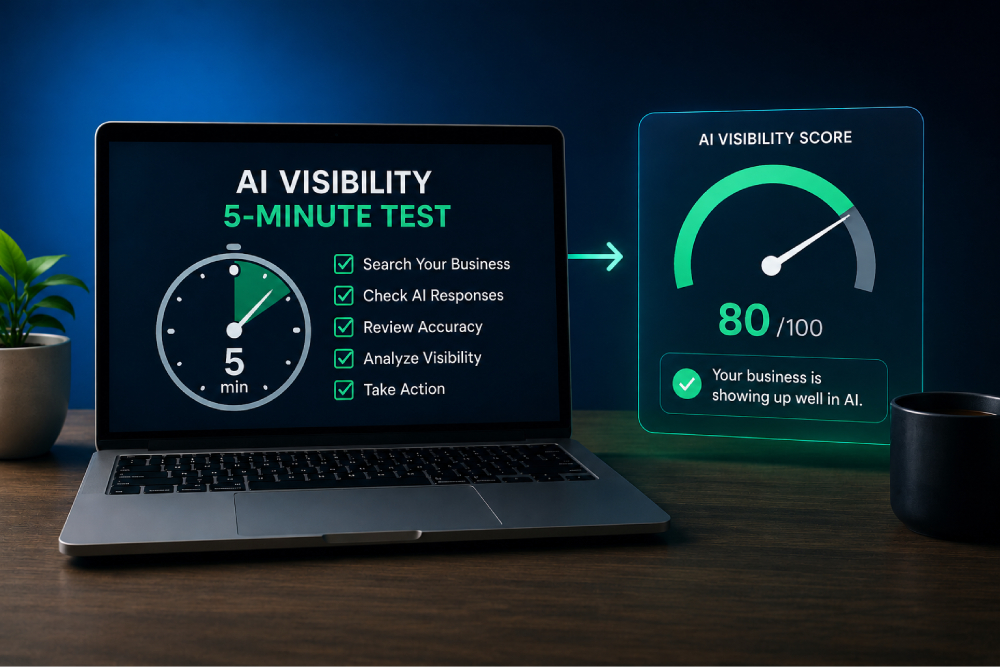
Most small business owners have never once checked their AI visibility that what ChatGPT or Google’s AI says about their own company. Not because they don’t care, but because it never occurred to them to look. They check their Google ranking sometimes. They check their reviews often. They have never opened an AI assistant and simply asked it about themselves, the way a stranger might right before deciding whether to call.
That is worth five minutes tonight, because a growing number of your customers are doing exactly that before they ever visit your website. They ask an AI assistant what a business does, whether it is any good, and what it costs, and they often decide whether to click through based entirely on that answer. For businesses looking into AI SEO Solutions for Small businesses, below is a short test you can run right now on your phone, a simple scoring system to make sense of what comes back, and what to actually do about it depending on where you land.
TL;DR
Most small business owners have never checked their AI visibility that what ChatGPT or Google’s AI actually says about their own company. This article gives you a 5-minute, 3-question test to run right now on your phone, plus a simple score (0 to 5) that tells you whether AI tools are helping customers find you or quietly getting in the way. Low scores usually come down to a vague About page, inconsistent business details across the web, and no direct answers to real customer questions, all of which are fixable in an afternoon.
Why This Test Matters More Than Another Ranking Report
A ranking report tells you where your website sits in a list of blue links. It says nothing about what happens when a customer skips the list entirely and just asks an AI assistant directly, which is happening more often every month, especially for exactly the kind of practical, decision-driving questions small business customers tend to ask.
This test is not about SEO theory. It is about finding out, in plain terms, whether AI tools currently help a prospective customer find and trust your business, or quietly get in the way without you ever knowing it happened. A customer who gets a vague, outdated, or wrong answer rarely tells the business about it. They simply move on to the next result, and the business never learns why a lead that should have converted never called.
Think of it the way you’d think of a storefront window at night, lit by a streetlight that only half the sign catches. Nobody complains about the sign. They just walk past without noticing it was ever there.
Run This Test Right Now
Open ChatGPT, Google’s AI mode, or Perplexity on your phone. Ask it these three questions, one at a time, replacing the bracketed parts with your own business details. Then check the box next to each one that describes what you actually got back, and the tool below will tally your score.
Question 1: “What does [your business name] do, and where is it located?”
Question 2: “How much does [your service/product] usually cost at [your business name]?”
Question 3: “Is [your business name] a good choice for [what you actually help with]?”
Check a box above to see your result.
What Your Score Actually Means
A score of 4 to 5 means AI tools already have a reasonably accurate, findable picture of your business. This is a good position to protect, not a reason to stop paying attention, since AI answers shift over time as the web around your business changes.
A score of 2 to 3 means AI tools know you exist but the picture is incomplete or slightly off. This is the most common score for small businesses, and it usually means quick, specific fixes rather than a rebuild.
A score of 0 to 1 means AI tools either cannot find enough about your business to answer confidently, or they are answering with outdated or incorrect information. This is more common than most owners expect, and it means a real customer asking the same question tonight is getting a worse answer than your business deserves.
What a Good Answer Sounds Like vs. a Bad One
It helps to know what you’re actually listening for when you run the test. A strong answer sounds specific and current: it names the business correctly, describes what it actually does today, and either states a price range or clearly says pricing depends on the job rather than guessing a number.
Why Small Businesses Score Low More Often Than They’d Expect
It rarely comes down to a bad website. Three quiet, ordinary gaps show up again and again.
The first is an “About” page that says a lot without actually saying what the business does, who it serves, or roughly what it costs, which are exactly the specifics an AI assistant needs to answer a direct question confidently. The second is inconsistency: a Google Business Profile that lists different hours or services than the website, which leaves an AI system guessing which version to trust. The third is having no page that plainly answers the questions customers actually ask out loud, since most small business sites are written to describe the business rather than to answer questions about it.
None of these require a redesign. They require specific, deliberate content decisions that most small businesses have simply never had a reason to think about before now.
Three Small Fixes That Move the Score Fastest
Start with a clear, plain-language paragraph near the top of the homepage or About page that states what the business does, who it is for, and a realistic sense of pricing or range. This single paragraph is often the single highest-impact fix available, since it gives an AI system a confident, quotable answer instead of forcing it to guess from scattered clues.
Next, add a short FAQ section using the actual questions customers ask before they buy, not generic ones. A landscaping company might answer “how much does a typical lawn care visit cost” or “do you work with small yards,” phrased exactly the way a real customer would ask.
Finally, check that the Google Business Profile, the website, and any directory listings agree on the basics: hours, services offered, service area, and pricing tier. A single contradiction across these sources is often the entire reason an AI system hedges or gives an outdated answer.
How Score, Meaning, and Fix Line Up
| Score | What It Means | First Fix to Try |
|---|---|---|
| 4-5 | AI tools have an accurate, findable picture | Recheck monthly to protect the position |
| 2-3 | Known, but the picture has gaps | Add a clear pricing paragraph and an FAQ section |
| 0-1 | Little or inaccurate information available | Fix Google Business Profile and website inconsistencies first |
How Often Should You Run This Test?
Running it once tells you where things stand today. Running it again every month is what actually tells you whether the fixes are working, since AI answers can shift as the web around a business changes, sometimes without any obvious trigger like a new review, a directory update, or a competitor publishing something that reshuffles what an AI system finds most confident.
A five-minute monthly check is a reasonable habit for any small business owner to build, ideally on the same day each month so it doesn’t quietly slip. Keep a simple note of the score and the exact wording of each answer, since a small wording change from month to month is often the first sign that something in the underlying information trail has shifted, for better or worse.
Anything beyond that, including tracking multiple AI platforms consistently, testing a wider set of buyer questions, or benchmarking against several competitors at once, is where dedicated AI SEO support starts to make more sense than doing it alone with a notes app.
Key Takeaways
- Most small business owners have never checked what AI assistants say about their own company, even as more customers ask AI directly before visiting a website.
- A simple three-question test on ChatGPT, Google AI, or Perplexity reveals whether AI tools currently help or quietly hurt customer discovery.
- Low scores are usually caused by vague About pages, inconsistent business details across the web, and a lack of direct answers to real customer questions.
- A clear one-paragraph business description, a real FAQ section, and consistent details across listings are the three fastest fixes.
- Running the test monthly, not just once, is what actually shows whether those fixes are working over time.
Frequently Asked Questions
Do I need any special tools to run this test?
No. Any free ChatGPT, Google AI mode, or Perplexity account is enough. The test takes about five minutes and needs nothing beyond a phone or a browser.
What if I get a different answer each time I ask?
That is normal and worth noting rather than ignoring. AI answers can vary between runs, so if the answer is right most of the time but wrong occasionally, that still points to a thin or inconsistent information trail worth fixing.
Is a low score my website’s fault specifically?
Not always. Outdated directory listings, old review site entries, and inconsistent Google Business Profile details are just as often the cause as anything on the website itself, which is why checking all of these sources matters more than fixing the site alone.
Will fixing these three things guarantee a perfect score next time?
Not guaranteed, but it reliably moves most small businesses up at least one score band within a few weeks, since these fixes address the most common causes of a low score directly.
Is this the same thing as traditional SEO?
It overlaps, since a clear, consistent, well-structured site helps both. But this test specifically checks how AI assistants represent a business today, which traditional rank-tracking tools do not show at all.
Should I be worried if a competitor’s answer sounds better than mine?
It’s useful information, not a reason to panic. Run the same three questions with a competitor’s name instead of your own, and treat the comparison as a checklist of what their information trail is doing better, rather than as a race to win.
Conclusion
Five minutes tonight is enough to find out something most small business owners are currently guessing about: what a customer sees when they ask AI about the business before ever visiting the website. A low score is not a verdict on the business itself. It is a specific, fixable gap in the information trail AI tools are relying on, and most of the fixes are things a business already knows how to do, just not something anyone had pointed at directly before.
If the test turns up more gaps than expected, that’s exactly the kind of work an AI SEO agency in India built around small business budgets can help close quickly, without needing a full website overhaul to do it.
