
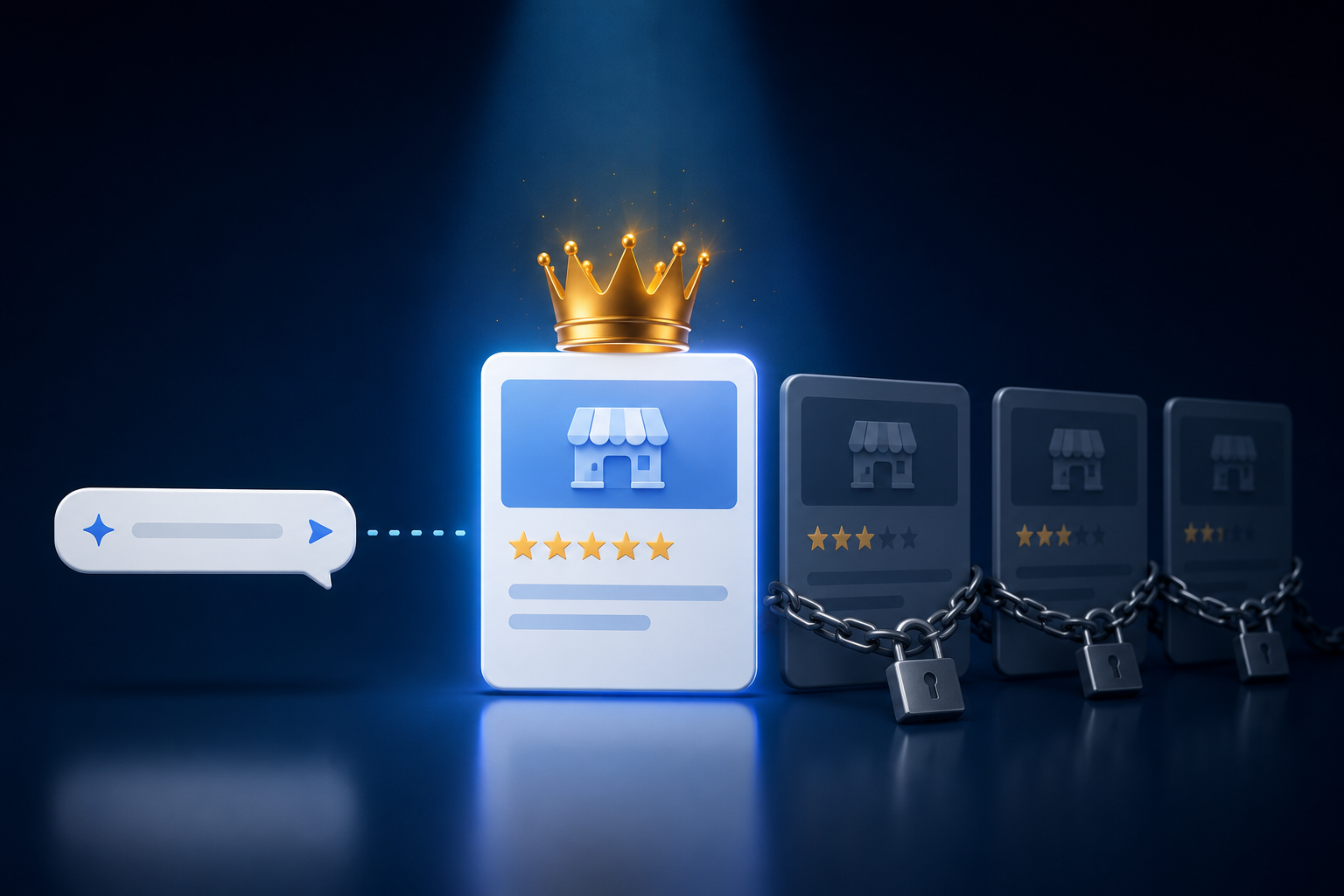
A business owner uses AI SEO and asks ChatGPT which local plumber, dentist, or accountant to use, gets a confident answer with two or three names in it, and closes the tab satisfied. Ask again next week with slightly different wording, and there is a real chance a different set of names comes back. That single fact makes a lot of business owners assume AI recommendations are basically random, and therefore nothing to worry about yet. That assumption is half right and half dangerous, and the half that’s wrong is the half that matters most.
TL;DR
New research shows AI brand recommendations vary far more than most people assume, with under a 1-in-100 chance that two runs of the identical prompt return the same list of brands. But that same research also shows brands that have built strong, independently corroborated signals get included far more consistently than brands that haven’t, while under-corroborated competitors get randomly included or excluded almost like a coin flip. Because AI SEO systems absorb signals into a corpus that’s expensive to update, the businesses that establish strong corroboration early get a durable head start that’s genuinely harder to unseat than an old-fashioned Google ranking ever was.
Why “Entrenchment” Sounds Wrong at First
Recent research from SparkToro, built on nearly 3,000 identical prompts run across ChatGPT, Claude, and Google’s AI, found the odds of two runs returning the exact same list of brands sit below 1 in 100, and the odds of the same order are closer to 1 in 1,000. List length varied too, with some responses naming two or three options and others naming ten. On the surface, that looks like the opposite of entrenchment: if the list keeps changing, how could any business get “locked in” as the default answer?
The honest answer is that list-level randomness and brand-level consistency are two different measurements, and the second one is where the real competitive advantage lives. A model generating a fresh response every time isn’t the same as a model being equally uncertain about every brand it could mention.
The Corroboration Threshold: Why Some Brands Appear Confidently and Others Vanish Half the Time
A brand that shows up in 90% of the runs for a relevant prompt is in a fundamentally different position than one that shows up in 40% of runs for that same exact prompt, even though both technically “got mentioned” at some point. The 40% brand is, in practical terms, invisible to roughly half the people who ever ask.
Industry analysis following the SparkToro data describes this as a corroboration threshold: brands with several independent, high-authority sources consistently repeating the same facts about them get treated with far more model confidence than brands with thin, inconsistent, or self-only sourcing. Once an entity crosses that threshold, it behaves close to consistent, appearing in the large majority of relevant runs. Below that threshold, inclusion becomes close to a coin flip, run to run, which from a business owner’s seat looks exactly like unpredictable bad luck rather than what it actually is: a measurable, fixable confidence gap.
Why Old, Wrong, or Thin Signals Stick Around Longer Than in Traditional SEO
Traditional SEO has a forgiving update cycle: a page changes, Google recrawls it, and the ranking shifts accordingly within days or weeks. AI SEO systems don’t work this way. A characterization of a business that’s been repeated across enough sources gets absorbed into the broader corpus the model draws from, and once it’s in there, it doesn’t automatically disappear just because the original source is edited or taken down.
This cuts both ways. A business with weak, inconsistent, or outdated information circulating about it carries that disadvantage for longer than a simple website fix would take to resolve. A business that establishes strong, consistent, well-corroborated signals early gets to carry that advantage for a similarly extended period, without needing to re-earn it every quarter the way a keyword ranking has to be defended.
What Being Early Actually Buys a Small Business
Being early doesn’t mean winning a permanent, uncontested spot forever. It means starting the corroboration-building process while most local competitors are still doing nothing, so that by the time they start paying attention, the gap isn’t zero, it’s a real head start built on signals that take time to accumulate no matter how much budget gets thrown at it later.
This matters more for small, local businesses than it might first appear, precisely because most direct competitors in a given city or category still haven’t done anything deliberate about AI visibility yet. The category isn’t crowded. It’s wide open, and it won’t stay that way as more competitors realize what’s happening. Search Engine Land’s coverage of the underlying research is worth reading directly for the full data behind this shift.
Traditional SEO vs. AI SEO Recommendation Dynamics
The table below summarizes the practical differences that make this window of opportunity real for small businesses moving now.
| Factor | Traditional SEO | AI SEO Recommendation Dynamics |
|---|---|---|
| Update cycle | Days to weeks after a page change | Slow; signals absorbed into a corpus that’s costly to revise |
| Consistency | Stable position for a given keyword | Highly variable below the corroboration threshold |
| What drives inclusion | Backlinks, on-page optimization, authority | Independent, third-party corroboration of the same facts |
| Competitive landscape today | Saturated for most valuable keywords | Wide open for most small, local categories |
How to Start Building Corroboration Now
Start with consistency before volume. The same facts about a business, phrased the same way, appearing across the business’s own site, directory listings, and any press or partner mentions, do more to build model confidence than a large volume of inconsistent or vague mentions.
Prioritize independent, third-party sources over self-published content. A fact stated only on a business’s own website carries less corroboration weight than the same fact echoed on a review platform, a local directory, an industry association listing, or a piece of press coverage, since AI systems are specifically weighing whether multiple independent sources agree.
Audit what’s already circulating before adding anything new. A business that finds outdated or incorrect information already sitting in its existing footprint should prioritize correcting that before publishing new content, since new corroboration built on top of a shaky foundation takes longer to compound. For a broader tactical breakdown of the levers involved, our 10-point guide to AI search dominance covers the full framework in more depth.
Key Takeaways
- AI recommendation lists vary far more than most business owners assume, with under a 1-in-100 chance of two identical prompts returning the same brand list.
- That list-level randomness is different from brand-level consistency: brands that cross a corroboration threshold get included far more reliably than brands that haven’t.
- Below the corroboration threshold, inclusion functions close to a coin flip, meaning a competitor’s absence from one answer says little about whether they’ll appear in the next.
- AI systems absorb signals into a corpus that’s slow to update, so both bad information and strong corroboration tend to persist longer than an equivalent traditional SEO ranking would.
- Being early doesn’t guarantee a permanent lock-in, but it starts the corroboration-building clock while most local competitors are still doing nothing.
- Consistency of facts across independent, third-party sources matters more at this stage than sheer volume of new content.
Frequently Asked Questions
Doesn’t the research showing AI SEO recommendations are random contradict the idea of a “first answer” advantage?
Not directly. The randomness measured in that research is at the level of which exact list appears on a given run. Brand-level consistency, meaning how often a specific business appears across many runs, is a separate measurement, and that’s where corroborated brands behave far more predictably than under-corroborated ones.
How long does it typically take to cross a meaningful corroboration threshold?
There’s no fixed timeline, since it depends on how much independent, third-party corroboration already exists for a given business and category. Businesses starting from very little existing footprint should expect this to take longer than businesses that already have some scattered directory and press presence to build on.
Is this only relevant for competitive, high-search-volume categories?
It’s actually more relevant for small, local categories precisely because most direct competitors haven’t done anything deliberate yet, which means the corroboration threshold is often easier to reach than in a saturated national category.
Can a business lose an established AI SEO visibility advantage once it has it?
Yes, if the underlying corroboration weakens, becomes outdated, or a competitor builds a stronger, more consistent footprint over time. It behaves more like an accumulated asset that needs occasional reinforcement than a one-time achievement.
Is this the same thing as traditional local SEO?
It overlaps in some of the same source types, like directories and citations, but traditional local SEO optimizes primarily for Google’s map pack and organic rankings. This is specifically about whether AI systems have enough independent corroboration to cite a business confidently and consistently.
What happens if a business waits another year to start on this?
The category doesn’t stay empty. Competitors who start building corroboration this year get a proportionally larger head start the longer everyone else waits, and reaching the same threshold later typically takes more concentrated effort than it would have taken to build gradually from an earlier start.
Conclusion
The businesses that treat AI SEO visibility as something to figure out later are the ones handing their local competitors a multi-month head start for free, in a category where most competitors currently aren’t paying attention at all. That gap doesn’t stay open indefinitely, and it doesn’t close evenly either, since the businesses that start building corroboration now are the ones setting the threshold everyone else will eventually have to catch up to.
Building the kind of corroborated, consistent footprint that crosses this threshold is exactly the ongoing work behind a properly run AI SEO strategy, and it’s considerably easier to build early than to catch up to later.
